

Bound By Broadway
The State of the American Musical
It is no secret that Broadway is the driving engine behind the development of new musical theater, largely because it’s one of the only ways a musical can be profitable. When musicals succeed on Broadway, an entire channel of distribution opportunities open up, from tours to licensed productions at regional theaters that have trained their audiences to expect a Broadway brand. The American musical had its origins as popular entertainment, coming from vaudeville and operetta, and while it has always been primarily a for-profit business, it was an essential part of the cultural landscape. Over the past few decades, however, the market reach of musicals has been reduced to a very specific niche market while the artistic ambitions of the artists that create it have continued to grow and evolve. The art form is driven by commercial success, but opportunities for that success have condensed as well, as even commercial Off-Broadway has become the realm of musicals that have achieved a Broadway brand first.
The result of this condensation of the available marketplace is that new musicals are increasingly being evaluated according to a Broadway paradigm. That is, will the musical appeal to a Broadway audience and have a chance at becoming profitable? The question of “Is this musical commercial?” that gets bandied about frequently amongst the producers of new musical theater, is in actuality, “Is this musical a Broadway show?” The prescience of that question in the annals of development of new work invariably limits the form by forcing that work into the specific and singular environment of Broadway theater.
Producing on Broadway doesn’t allow for a variance of options. The available theaters are mostly old, landmarked, and proscenium spaces located in a twenty-block section of one city. The costs are exorbitant and so are the ticket prices, resulting in an audience made up of mostly white, well-off individuals from the suburbs and tourists on vacation. Even with these limitations, it remains one of the few launching pads for new musical theater with a profitable upside, and as long as it remains the sole viable distribution point for new musicals, the art form’s evolution will be severely curtailed.
The community of readers here at HowlRound will recognize some of these same issues in the development of new plays, but for all of the talk throughout the theatrical community of the plight of the playwright, the reality is that while there are income and livelihood issues of great importance that need to be addressed with playwrights, the fact remains that there are plenty of institutions throughout the U.S. that are dedicated to the development of new American plays and frequently produce them. These writers may not be able to make a living off their plays, but there is at least a chance they will have them done. There are currently no major non-profit producing theaters in this country whose core or sole mission is the development and production of new musicals. Though major regional theaters will occasionally mount brand new musicals in their seasons, when they take one on it is often a project that has been incepted or optioned by a commercial Broadway producer who has made a substantial enhancement to the theater’s budget. There’s nothing inherently negative about this arrangement. Often, it is an effective development tool for these producers. But it feeds the notion that the granting of artistic life to a new work of musical theater is solely tied into its viability as a Broadway property.
Though major regional theaters will occasionally mount brand new musicals in their seasons, when they take one on it is often a project that has been incepted or optioned by a commercial Broadway producer who has made a substantial enhancement to the theater’s budget. There’s nothing inherently negative about this arrangement. Often, it is an effective development tool for these producers. But it feeds the notion that the granting of artistic life to a new work of musical theater is solely tied into its viability as a Broadway property.
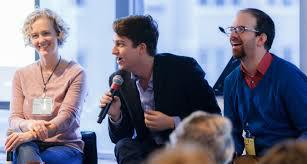
Photo by Jeffery Lee, On the Spot Image.
So what do the writers of musicals do with their ideas that don’t get traction commercially, aren’t perceived as commercially viable or simply aren’t right for the types of spaces available on Broadway? There are service organizations like the National Alliance for Musical Theater and the BMI Workshop, and various festivals that provide matchmaking, nurturing, and early stage opportunities to writers, but where does the next generation of musical theater composers, lyricists, and bookwriters go to grow? Where do they go to dream, experiment, and perhaps even be allowed to fail? What are the intermediate steps for them? We have a crop of very talented and promising musical theater artists coming up through the ranks who have never had a fully realized professional production of their work. Through their frustration, they begin to write shows that are scalable and that can work effectively in a festival environment, or even worse, they learn to write for the music stand. They aren’t getting the opportunities to see their work done theatrically with a professional team or paying audiences…experiences that are invaluable and essential to their artistic and creative growth.
The Broadway producing community should find this issue worrisome, as it won’t be long before it begins to impact their product pipeline. No matter how corporate or commercial the ideas for new musicals become, there will still be a need for competent writers who understand the form and can translate these ideas into something theatrical. While the Broadway business model itself isn’t necessarily flawed (when it works it works big and because of the incredible pay-off potential it’s not likely to dramatically change soon), the fact remains, there are few, if any, other options currently available. Here’s why it’s incredibly problematic if the sole tastemakers of musical theater are Broadway producers: the very nature of producing commercially on Broadway disallows for the sharing of ideas and concepts and more global discussions of what the art form could be or should be evolving towards. These producers have a fiscal responsibility to their investors and are often very project-by-project focused.
The complexity of mounting a show on Broadway makes it nearly impossible to be concerned with the uber issues of the art while they are in the thick of it. The perspective these producers could provide in an aesthetic discussion of musical theater would be invaluable, but these discussions rarely happen amongst the commercial producing community, as there are no strong counterbalances to their perspective. Differing perspectives that might provide this balance are hard to come by in official or credible channels, as the criticism and academic discussions of musical theater as an art form are considerably limited. Many of the books written about musicals are from a historical or popular culture point of view, dealing more with the personalities of the players or the business successes or failures of certain productions as opposed to a dramaturgical assessment of creative and artistic success or effectiveness. These works frequently are loaded with nostalgia for the “golden age” of musical theater and often lament the progress and changes made to the form such as the influx and incorporation of more modern musical stylings and narrative structures.
In addition, there are few educational institutions with programs that encourage the artistic exploration of the form at the graduate level that are not performance-based. In fact, because musical theater exists primarily in the commercial mode, the form is looked down upon by many theater makers and is considered to be more akin to the latest big-budget Hollywood romantic comedy than a worthy form of artistic expression. This might be partially attributed to the fact that the form is relatively young and has yet to reach a highbrow status (if you start counting at Oklahoma, book musicals as we know them have only existed for seventy years). But I believe that musical theater has matured to a point where it will be difficult to grow any further until it begins to be treated with the same reverence and aesthetic scrutiny that we place upon plays. There are artists out there who are passionate about the form with varying ideas, who want to create work that is envelope-pushing, different, and meaningful, but who need institutions that want to nurture new voices in musical theater.
In order for the full potential of the American musical to be reached, we will need institutions that will give these artists the chance to grow in an environment free from the pressures of commercial Broadway entertainment and expectations of financial success, allowing us to better differentiate between musicals that are purely populist and musicals that have aesthetic significance. Though popularity and the essentialness of a work of art may be linked, they are certainly not dependent upon one another. In fact works of art that are progressive and unfamiliar may not be fully understood by the public at the time their creation. It is the reason that major not-profit cultural institutions exist: to provide the artist with a space to showcase their work that is not entirely dependent upon the forces of capitalism and the malleable nature of public opinion moving favorably in their direction. So must it be with musical theater if it is ever to mature and take its place among the great art forms.
Mass appeal, or a perceived potential for it, cannot be the only reason a piece of musical theater is brought into the world. All of this is not to say that the Broadway model is counter to the creation of great works of art. Indeed, Broadway is one of our country’s most cherished and important cultural landmarks. However, as costs continue to skyrocket it becomes increasingly difficult for it to be a place where this kind of progressive artistic success happens with any consistency or regularity. Broadway can and should continue to exist as the ultimate goal and top-level distribution point for works that are called to reach a wide audience. But there must be opportunities for musical theater to thrive and exist outside the Broadway sphere. Our definitions of success must be broadened so that we can feed both the future of the form and Broadway itself.


Comments
The article is just the start of the conversation—we want to know what you think about this subject, too! HowlRound is a space for knowledge-sharing, and we welcome spirited, thoughtful, and on-topic dialogue. Find our full comments policy here.
13 years later and this article is still very timely. Reaching out to you to continue the conversation! There's a lot of progress in new musical development, but with the squeeze of grants being defunded, we have to keep looking at his issue from different angles.
Excellent essay, sir. If it is a fact that the Gatekeepers for even the development of musical theatre are self-interested, then the artists will have a tougher go of it when their formula does not press the correct buttons of potential profit. Not good for the pure craft.
Scott, I believe you might be taking some of my comments out of context, or at least misunderstanding me. Im not trying to speak in absolutes or claim that there is a universality to what's going on in this art form. I'm merely speaking about observable trends that are very real, but of course aren't adhered to exclusively by everyone producing musical theater in the US.
I stand by the fact that for the large component of writers and producers (both for and not for profit) the endgame is a Broadway production to launch their brand, which in turn colors the kinds of work that gets written and produced. The majority of musicals that end up in catalogues and get licensed with any regularity are Broadway or Off Broadway titles. Your own current season consists entirely of shows that had Broadway runs before entering into the regional world. Yes, you have done world premieres and work that hasn't been seen in new york in the past, but for even a theater like yours that does make a point to develop new musicals, the bulk of your programming ends up being shows that were birthed in New York. Perhaps there just aren't enough new musicals that are ready for production to fill a season... this is the plight I'm sort of attempting to wrestle with here, how do we find a considered way to develop new work (and new writers) and raise awareness of it so that it continues to be produced without a New York production? How do we allow Musical Theater to stand on its own as an art form as it grows and evolves...and how do we nurture that evolution.
Stop equating the art form of musical theatre with Broadway -- the two have been largely separate for decades now. Open your eyes. While what you write above may be true in New York City, it's not true across the rest of America. Amazing new musicals are being written every day across the country, with zero thought as to whether they would appeal to the tourists who buy Broadway tickets. And dozens of regional theatres like New Line Theatre in St. Louis (www.NewLineTheatre.com) produce these new works, regardless of whether they've been to, or will ever get to, New York.
And by the way, you need to brush up on your musical theatre history -- you have a very simplistic and flawed perspective of how our art form has evolved. I'd suggest my book, "Strike Up the Band: A New History of Musical Theatre." Though you mistakenly claim there aren't any books that offer "a dramaturgical assessment of creative and artistic success or effectiveness," my six books on the art form do exactly that -- From Assassins to West Side Story, Deconstructing Harold Hill, Rebels with Applause, Let the Sun Shine In, Strike Up the Band, and Sex, Drugs, Rock & Roll, and Musicals.
Scott,
Thanks for reading and weighing in. I'm in full agreement with you that the art form and Broadway aren't one in the same, its one of the points I'm trying to make! They aren't and shouldnt be thought of that way, but the fact remains that many artists and audiences and fans of the form still equate the two with one another, which is to its detriment I believe. I agree that amazing new musicals are being written I just wish they were being produced more, especially without commercial involvement in our larger institutions. I grant that my perspective is skewed from my experiences with the industry here in New York, but this is also a major component of my readership, and hopefully these discussions will help to alter some of these perceptions.
I'm actually quite aware of the diverse and complex evolution of the art form. As you I'm sure know having written several books on the subject, there simply wouldn't have been room in this short piece on its current state to delve into too much detail. Also in my article I don't claim that there aren't any writings from a dramaturgical perspective, I merely state, accurately, that there aren't many, especially in comparison with the wealth and expanse of material available about plays.
One of the things I'm most grateful for in the publishing of this piece is the spirited and passionate discussion it has illicited. Thanks for being a part of that. I'm also happy to be introduced to someone who is out there that is bucking the trends I'm talking about.
Ryan, you say you know the art form and commercial theatre in NYC aren't the same (and I'm relieved to hear that), but your argument starts with references to both Broadway and profit, and you say "the art form is driven by commercial success," which is demonstrably not true. And you say "new musicals are increasingly being evaluated according to a Broadway paradigm" which is also not true and getting less true every day. You warn of the danger that "the sole tastemakers of musical theater are Broadway producers," but again, that has not been true for decades. What you call for at the end of your piece is already happening and has been for awhile. That you are not aware (or fully aware) of it does not mean it is not happening.
And by the way, the American musical theatre did not come from vaudeville and operetta, and there were integrated book musicals before Show Boat.
-- Scott Miller, http://newlinetheatre.blogs...
Ryan - you may want to also look at Rarely Done Productions in Syracuse. I have a friend, Scott Martin, who has began writing musicals here in Ohio 25 years ago, then moved to my hometown of L.A., where another of my good friends choreographed one of his musicals there, "Scream Queens", which got rave reviews (produced at an under-99 house and reviewed by both Daily Variety and The Hollywood Reporter, I believe) and was revived a year later because of demand. He was lucky enough to get it picked up and published by Samuel French two years ago and I was lucky enough to co-direct and music direct the Midwest premiere last year. That was how I discovered Rarely Done - Scott told me that Rarely Done had beat us to the punch at being the first house outside the original production to produce the musical. We made the six hour drive to Syracuse see their production several months before our own and the founder/director Dan Tursi was a wonderful host and continues to look for rarities (both plays and musicals) to produce at Rarely Done.
Scott Martin himself continues to support his musical-creating enterprises by directing at small houses (read: community theatres) around L.A., who give him to opportunity to then produce and direct his own work in their houses, which sometimes garners the notice of regional theatres/major publications in Southern California.
I am glad you mentioned your "New York provincialism", because I think that can skewer one's point of view - the idea that since New York considers itself the center of the (theatre) world, hits/works outside of New York tend to get overlooked (or looked down upon) by New York media.
I was however, struck by your comment "there are few educational institutions with programs that encourage the artistic exploration of the form at the graduate level that are not performance-based." I think that because it has rarely existed, I did not even think what differences that could make within the musical theatre world if one were able to pursue graduate level education in the creation/development of musicals as a librettist/composer/producer.
Eric,
Thanks for reminding us all about Rarely Done. I think many of the smaller and mid-sized organizations outside of New York are often overlooked by the New York Theater community. (Guilty as charged).
As far as the educational programs that are out there, the only graduate musical theater writing program I'm aware of is the one at NYU.
My own particular curriculum in the Theatre Management and Producing MFA program at Columbia is pretty keyed into the Broadway world faculty wise, so we do get a lot of great insight into that kind of development and business, but the larger theater arts program it is a part of is very much focused on plays. (There aren't any classes on musical theater available in the entire university in point of fact.)
Polly Carl had a great post about the importance of recognizing that our art form is one of collaboration in the blog on this site a few days ago. Musical Theater is even more of a collaborative art form than the creation of straight plays in the sense that there are typically many more collaborators involved. It would be a great thing if there was some kind of educational program on either the grad or undergrad level that gave directors, composers, lyricists, librettists, choreographers, actors and producers a chance to build shows together. If anyone knows of a program like this existing that I'm just not aware of I'd love to hear more about it!
Really interesting read, glad someone posted it to Reddit!
I think you've hit the nail on the head with this critique of the Broadway paradigm, I'd be interested to hear your thoughts on possible solutions?
I spend a lot of my time thinking about exactly what you've addressed here, considering I am studying music and want to be a musical theatre composer, but the only solution that jumps out to me are the possibilities of the internet. I can point to two examples (though maybe there are more that aren't on my radar): The Very Potter Musical, which was done by university students and produced the new Broadway celebrity, Darren Criss, and Dr. Horrible's Sing-a-long Blog, by critically acclaimed director Joss Whedon. Though both are lighthearted comedies, I think they might be a good model for something where new works could be found by people outside the typical musical-theatre crowd. Would love to discuss more...
Wesley,
Great points there. I think this brings up a whole other issue of the theatrical field being generally wary of new media. I understand the trepidation...we deal in an art form that is meant to be experienced live and when its recorded it literally becomes a different kind of art. However, creating alternative content that's meant to be viewed on the web (like Dr. Horrible) that is related to a new musical might be a great way to build an audience and get them familiar with the art form and the particular show. Would definitely love to chat about all that more.
Erich, I'm afraid I have to disagree with you here.
I don't agree that musical theater has to contain a popular element to be successful, or that it can't be transcendent. Sweeney Todd, for example, is not based on a popular story and I think it could be as enduring as Don Giovanni. Part of what is keeping musical theater from reaching its full potential as an art form is the idea that it must be populist and "low-brow." Perhaps I'm a dreamer, but I believe the best work in the form has yet to be written.
As a theater whose entire year-long is dedicated to the full production of new musicals (Kent Nicholson forgot us...remind me to beat you up Kent! :-) ) we here at The Spirit of Broadway Theater (Norwich, CT) exist WITHOUT enhancement money, without national corporate sponsors and are celebrating our 15th season. We do not believe the NYC (or even NYLACHI) are the pinnacles of greatness that musical theater should aspire to conquer.
Yes, there are massive challenges confronting the industry that transcend the chaos of the economy: notably, entrenched and regressive thinking on the part of the industry that the BROADWAY label is the "validation" of the worthiness of a piece for either publication or future productions. This thinking does NOTHING to advance the future of musical and yet, I content, it seems to be THE major hurdle in producing new musicals in fully staged productions as part of a regular season.
I support Kent Nicholson when he states " Regional theaters should follow their mission and produce what they feel has artistic merit...and they shouldn't care if commercial producers get interested in it or not." Unfortunately, for all us of in this industry, we know that the art far too often takes a backseat to the business. While great musical theater needs business from a financial point, that "influence" can corrupt the musical itself, forcing it to be something it was never intended to be: something commercial. Going a step further, it is up to us in this industry to make clear our commitment to an artistic vision that furthers and advances the musical theater form. Selling the show to the highest bidder may come with money, but it does not always serve the musical or the art form.
Finally, I think there is so little fascination at the academic level with producing new musicals for one simple reason: they do not know how to access the field of new works. As a member of The National Alliance for Musical Theater and as a working professional in the theater industry whose entire career has been spent on producing new musicals, I am continually approached by people who want to know HOW to find new works. There needs to be a larger discussion - a discussion beyond membership organizations and internal industry functions - within the larger academic and regional theater world if new works are to find homes beyond the few of us who actively seek them out and bring them to life.
Brent,
Thanks for your comments, and thanks for doing the work that you are doing! I'd love to know your organization better. What do you have on the docket? Maybe a trip up to Norwich is in order!
Ryan,
Check out our webpage, www.spiritofbroadway.org. We started 2012 with THE BOY IN THE BATHROOM, (great reviews from broadwayWorld.org), soon to open NUMBER THE STARS, followed by DESPERATE MEASURES, THE NEWPORT PRINCESS and our only published show this season, the musical, WINGS. Celebrating 15 years of new musicals!! If you want to take a road trip to Norwich, I will even cover your hotel room, although we are only 2 hours outside of NYC.
Great discussion!!!
Brett,
Im definitely going to take you up on that offer. I'm so happy this article has spurred this discussion and introduced me to new people and organizations that are as passionate about these issues as I am!
Ryan - Thank you for your insightful analysis of the commercial theater and some of the inherent problems in its research and development models. You point to quite a few challenges that exist in the world of new musical development and in my experience, the conclusions you draw are ones that I have often commented on myself. I would add that the problem is more rooted in a deep seated provincialism. This provincialism makes the problem simultaneously more and less dire than your essay suggests.
On the positive side, there are theaters across the country whose missions do include new musicals (not exclusively, as you point out, but certainly inclusively). My own Playwrights Horizons includes composers and lyricists in their mission statement as playwrights. Goodspeed Musicals has the Norma Terris (exclusively dedicated to new musicals), 5th Avenue is starting its new works programming in co-operation with A.C.T. in Seattle, and TheatreWorks in Silicon Valley has a festival of new musicals and a long track record of producing world premieres. There are countless others, most of whom belong to The National Alliance for Musical Theater, which you reference above. Far more than simply providing early stage matchmaking, NAMT is a service organization comprised of producers of musicals, currently 150 of them across 34 states. A major part of NAMT's mission is to promote new musicals to their membership. Additionally, theaters such as Dallas Theater Center, Portland Center Stage and others are putting on new musicals without the benefit of commercial enhancement.
So with all this activity, what's the problem?
The first problem is that most commercial and NY based theaters don't bother to look much outside of NY for their inspiration. And, to your point, the idea that there is money to be made by not bringing a show into NY, but rather licensing it through a series of successful regional productions makes no sense to them. They are simply not willing to explore business models outside the ones they know work. And right now, in terms of regional theater, what works is enhancement money.
This is the second, and probably most insidious problem hampering the development of musicals. Enhancement, in and of itself isn't evil, but there is an over-reliance on it on the part of most non-profit musical theater producers. It has led to the large majority of projects being shepherded by the commercial, Broadway-esque model that you write about. Rather than commercial producers taking a chance on the successful regional projects that are being developed by theaters with a long track record, those regionals are being lured by the promise of money to produce the projects that are the brainchildren of commercial producers.
This is where commercialism begins to exert an undue influence on the entire eco-system. Regional theaters need to stand up and say no. They need to follow their mission and produce projects they are passionate about and convince the commercial industry to look past the Hudson River for projects. A more holistic approach to the fostering and development of new musicals would create a healthier, more vibrant, and interesting musical theater.
Kent,
Thanks so much for your comments! I always enjoy reading and hearing your thoughts on issues like these and was hoping you'd catch this article and weigh in.
I perhaps was a little unfair in my characterization of the NFP theater world as far as development of new musicals go. This is probably due to my own New York City provincialism! Which as you astutely point out is a large problem in the commercial theater community.
That being said, many of the organizations you mention are reluctant to produce new musicals in their mainstage spaces unless they have commercial enhancement. This is a complex problem and has as much to do with audience development as creative development I think.
NAMT does do a great job of introducing their membership to new work, but sadly it's a rarity that the musicals showcased at the Festival end up in any of those member organizations seasons with frequency. I worked in theatrical licensing for a time, and was always surprised how many professional companies would much rather do a Broadway title that was a perhaps weaker show over something that was of better quality that had come to our catalogue from a regional production or off-broadway run.
I wonder if part of the issue with regional producers being reluctant to work on a new musical without the aid of commercial enhancement has as much to do with a value judgement placed on the idea of a Broadway brand and the cache that comes from having a Broadway transfer. I also should point out that, like you, I don't think the enhancement arrangement is inherently evil...it just limits the art form if it ends up being the only way the work is getting done.
I couldn't agree more with your final comment, and I would take it even one step further. Regional theaters should follow their mission and produce what they feel has artistic merit...and they shouldn't care if commercial producers get interested in it or not. In my mind we'd be better served if this was a welcome bonus, not a strategic goal. The irony of course is that by taking this approach they'd likely end up with with much more interesting work that over time might eventually draw the attention of those Broadway producers we're talking about.
Good musical theatre contains a popular element, an aesthetic that is easily enjoyed, and idea that is immediately approachable and therefore able to be produced (and endlessly reproduced) for a profit. This accessibility goes hand in glove with our western sensibilities but does not necessarily make it an art form (unless one is talking about the general idea that well-crafted or practiced idioms achieve a sort of excellence or efficiency that demands acclaim). Art is transcendent. Showboat or Oklahoma or Hair or Cats or Rent grow quickly dated when compared to the power and beauty of say, Don Giovanni or Swan Lake or Mahler’s first symphony, don’t you think?
I'm glad my response started a dialogue. Ryan - I think we agree about enhancements, but all the companies I mentioned have done it without enhancements. Some have done it with enhancements as well, but they have demonstrated on some level that it's possible to do without. That's what seems key to me. I do think your overall point is correct though. There is a fallacy (or fear, or intimidation, or bias, or something) that somehow, unless its commercial, musicals can't be successful. Many of the most successful shows in recent memory have not been obviously commercial in their origins (Spring Awakening and Avenue Q anyone?). There is terrific new work going on all over, most of it ignored and doomed to die without the all powerful Broadway brand. We all need to think a little more out of the box to figure out ways to get it into world. Something that NAMT is specifically trying to solve. And how could I forget Spirit of Broadway and the terrific work Brett Bernardini! A trip to Norwich is definitely in order.
Kent...you are forgiven! :-) You always inspire me...truly! I am grateful for your friendship, your insight and the zillions of laughs! Great discussion!!!
Kent,
Thanks so much for your insight. I'm so glad this dialogue is happening in more places that I was aware of. It's clear that those of us that are passionate about this issue are going to have to come up with some solutions for how to get work out there in alternative ways. As you mentioned, NAMT has been working on this. I've been lucky enough to be getting to know the fantastic Gigi Bolt, who is one of my professors at Columbia and who is consulting with them on that issue. I'm hopeful they will be successful in their efforts to facilitate a more considered path of development for new musicals.
I might put the age of the American musical back a bit earlier: http://en.wikipedia.org/wik...
I look out our office window across Broadway where The Black Crook originally debuted at Prince St. and dream of producing a modern, site-specific version of it. (The theater district was much further south back then.) I can't solve the important issue raised in this post, but if anyone is interested in adapting, writing music, or just collaborating on a new BC, feel free to hit me up: [email protected]
I guess it depends on what you consider musical theater to be aesthetically. For me, what makes the American Book Musical special is the unity of song and scene. Oklaholma was (IMHO) the first time that we were given a theatrical world where the characters sometimes sung instead of spoke to further the action. Regardless of what you consider to be the first (I'm sure there's a lot of people that might start with say, Showboat), the Book Musical is certainly a much newer art for than say, Opera or Ballet.