

How Going Local Can Revitalize American Theatre
Twenty-five hundred years ago in ancient Athens, theatre shaped the body politic. It was a sacred space where commoners and leaders sat side by side and watched their most pressing national questions dramatized and choreographed. In America, however, neither our leaders nor our citizens flock to the theatre, and our playwrights, unlike Sophocles (or Václav Havel for that matter), do not serve as national leaders. So what has changed in twenty-five hundred years? Why has theatre been relegated to the periphery of the national dialogue in America and, more importantly, what can we, American theatre artists, do to rediscover our sense of purpose?
For me, a rediscovery of that purpose begins with a frank admission of what theatre cannot accomplish in twenty-first-century America: it cannot act as a catalyst for a national transformation. I feel confident saying that there is no American playwright who will incite the masses against the King Louis’ of our day as Beaumarchais’ The Marriage of Figaro did, foreshadowing the French Revolution. The current social and political conditions make it impossible for a play to take a major role in contemporary political discourse. The manifold reasons for this include the absence of a national theatre; prohibitive ticket prices that have produced a predominantly monolithic, bourgeois audience; and the fragmented nature of twenty-first-century America. Certainly, the immensity of our country makes it exceedingly difficult for a work of art, particularly one that thrives on direct contact between performer and audience, to reach a critical mass of people. Unlike major motion pictures and YouTube videos, live performances cannot replicate themselves and be viewed in multiple locations simultaneously, and, if they are, then their impact is instantly diminished. The magic of theatre derives from its immediacy. Because of this, it can never truly go viral, which means it is doomed to play second fiddle in matters of social change.
So what is theatre to do now that online media and forums such as YouTube and Facebook have become the primary venues for social discourse and public performance? One possible answer is to identify what virtual media cannot provide, such as a sense of community and a connection to a tangible, geographic location, and to offer these things in greater quantity at the theatre. In other words, the theatre must go local. It can take a lesson from the locavore movement, a form of social and ecological activism that champions community and resists the fragmentation brought about by the Information Age, and transform itself into a gathering place for a group of people, not a viewing space for a disparate collection of individuals.
There are three steps that the theatre can take to hasten this transformation: 1) Get out of the theatre more. 2) Produce multidisciplinary works that involve collaboration with local artists. 3) Seek out plays that are more geographically specific.
A theatre company should be connected to the city in which it finds itself, and if it never ventures beyond the confines of its own space, then that relationship is very limited.
In the modern era, the theatre has become increasingly private. My use of the word “private” here has two meanings. First, the theatre no longer belongs to the public. The market squares that played host to commedia dell’arte performances have been replaced by formidable buildings where spectators are no more than guests passing through. Today’s audience member is a visitor in a place that he should be able to call home. Second, the theatre experience has become completely private and individualized. People, myself included, often go to the theatre expecting to be left alone. They go seeking a personal experience, not a communal one. One possible antidote to this problem is to utilize more nontraditional performance venues.
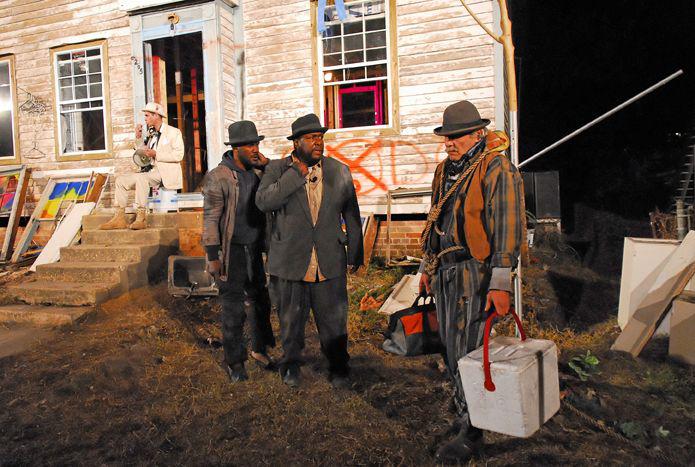
A theatre company should be connected to the city in which it finds itself, and if it never ventures beyond the confines of its own space, then that relationship is very limited. A major component of Shakespeare in the Park’s success is the public venue. That space belongs not to a company, but to the people. Consequently, individuals who do not usually attend the theatre make the trek to watch a play they would otherwise not see. Other successful site-specific performances include the work of Punchdrunk and the Classical Theatre of Harlem’s 2007 production of Waiting for Godot on a street corner in the Ninth Ward of New Orleans. For me, the latter production is a seminal example of the kind of service and communal healing that theatre can offer. A theatre can also do things to transform itself into a public space. There is no reason that every theatre in the country cannot collect food for local food banks, host blood drives, or serve as a location for Alcoholic Anonymous (AA) meetings. Not only would such actions benefit the community, but they would also deepen the theatre’s connection to its audience.
Increasing collaboration with local bands, painters, and dancers is another way for a theatre to expand beyond its walls. Why can’t Chekhov be done with live, local music, and is there a good reason not to use paintings and other pieces of visual art in a production-design scheme? The Greeks envisioned theatre as a multidisciplinary organism. The segmentation of artistic disciplines is a relatively recent phenomenon. One way to combat this unfortunate turn in history is to tear down the artificial barriers that separate the arts. As long as theatre remains a place for one type of artist, it can only do so much. But if it finds ways to include all the arts, its influence will certainly grow.
When I worked as a script reader in a literary office, I was struck by the paltry number of texts that focused on a specific location, culture, or region. So many realistic plays, including the good ones, take place in offices and apartments that could be anywhere. Even plays that are set in a particular city seldom explore issues of cultural identity and geography. As a result, theatre is almost utterly devoid of regional character. If theatres are unwilling or unable to explore what is happening in their own backyard, then how can they assist in the process of community formation?
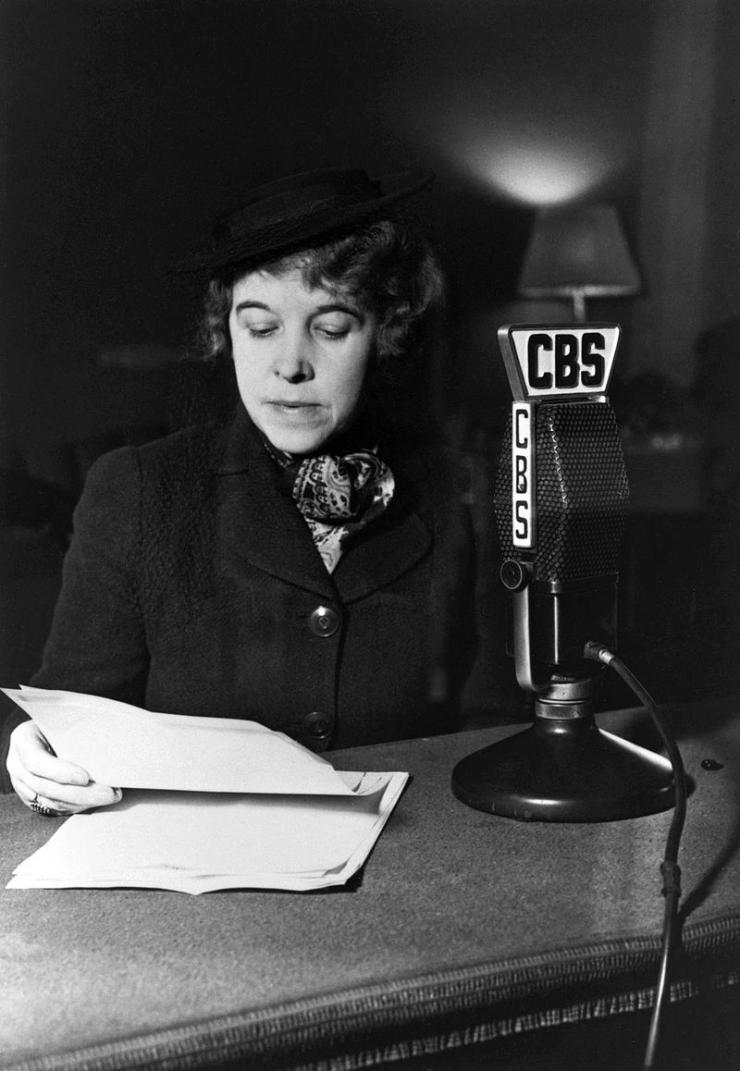
on CBS Radio for the Federal Theatre of the Air (1936). Photo courtesy of
Marshall Botvinick.
If theatres are unwilling or unable to explore what is happening in their own backyard, then how can they assist in the process of community formation?
One recent innovation, the concept of a rolling world premiere, is a tacit admission that new work need not have any connection to the city/cities in which it is created. In fact, it is encouraging work that is not specific to any one community. (I should note that despite this problem I recognize the economic value of this model as well as its potential benefits for playwrights seeking a larger audience and, certainly, we should do what we can to encourage the spread of our best plays across the country. However, we should be aware that this sometimes hinders a theatre’s ability to serve its particular community.) So what would a community-based theatre look like? I point my readers to the 1930s and the Federal Theatre Project. Hallie Flanagan, the national director of the Federal Theatre Project, had the genius to recognize that theatre must target specific populations and be responsive to local issues. As a result, in no other time has our country produced such regionally diverse works and, not coincidentally, in no other time has our theatre been more lively or topical.
Today, American theatre artists are faced with a choice. In our work we must prioritize either breadth of impact or depth of impact. Given the current state of affairs, I argue that we must pursue depth of impact. Our art may no longer be the spark that ignites a revolution, but it can still be the necessary spark in the dark to heal a broken community if we just take the time to connect.


Comments
The article is just the start of the conversation—we want to know what you think about this subject, too! HowlRound is a space for knowledge-sharing, and we welcome spirited, thoughtful, and on-topic dialogue. Find our full comments policy here.
Dear Marshall,
I am Matt Wolf of the Guardian. What about an interview about Violence in Irish Drama past and Present.
I would be grateful if you accept my invitation..
The tragedy was that arts councils around the country fed the theatre scene (as long as the plays were politically correct) and now that the money has dried up the people running them are anti- capitalist and ill prepared to compete in the market place.
Horton Foote wrote about idiosyncratic people from a pinprick town in a redneck state. Yet his characters and their yearnings speak to a universal longing that's palpable in whatever city or chair you're sitting in when you hear his words. "Local" doesn't have to mean small; local doesn't necessarily translate to "provencial". When a writer chooses a place to tell a story it is hopefully to tell it with a specificity that mines a cultural relevancy in a different voice than we might otherwise hear. And, perhaps because of that specificity, perhaps because we're listening differently, we might actually hear it. Better. More deeply. More fully. The opposite of Twitter. Embracing that experienciaql difference, not defending or fighting against it, is what theatre can do. Specifically. Great article, Marshall.
Thanks for this great article! I'm a huge advocate for the local movement - I think this is where it's all happening, and where it's all going to be happening when larger organizations are toppled by their enormous, unsustainable budgets.
But I - like some others - would argue the point that creating specific "place" plays are a necessary part of the solution. What I think is more critical is creating plays in the place is HERE. Too often those plays in apartments that could be anywhere are located in some OTHER place, filled with OTHER charcters who do the kinds of OTHER things that we would never do. "Godot" - for example - takes place in a very specific non-specific place, but a place in which we recognized some part of ourselves and our situation.
I also would argue that plays can and do create social change - perhaps more meaningfully and deeply than some of our faster, tech driven modes of transformation (especially when a dialogue within a community happens as part of the work). BUT that change isn't going to feel as sexy, and it may not have the immediate, overnight impact of a twitter movement. I tell my students that to be in the theater and be happy you have to find worth in the fact that you will affect people in smaller batches, but it doesn't mean you'll affect them any less.
For example, the seats in my theater in Idaho are filled every night with truck drivers, nurses, smoke jumpers, construction workers - people who anywhere else would be considered non-traditional theater-goers... and their kids. We worked with them when they were high school students - now they are grown-ups. That takes a while. Like theater, like local food, is also slower to cook sometimes - but the flavors are deeper and more complex and it leaves you wanting more.
Great article. My very specific play about the race riot in my hometown (Omaha)in 1969, My Occasion of Sin, was premiered in Omaha by Shelterbelt Theater this past April. We just received the TAG Award for Best New Script for this well-received and emotionally charged play about race and music. We had talkbacks with the audience that included respondents who had lived through the riot. My director, Roxanne Wach, scoured the area for photos of the time period, and I saw how much these photos, of segregated South Omaha (white) and North Omaha (black) effected the audiences as they were projected during scene changes. The city was itself a character in the play. A subsequent staged reading at Penguin Rep in New York proved the universality of the script. I highly recommend working this way. New York is NOT the universe.
So true. I, and many that I know, feel a great pride in where we are, or where we're from. I hold loyalties to Chicago (where I live) as well as New York (born and raised). In both cities, we extol the virtues of our home, and in the theater communities in particular, we say that the work done there cannot be done elsewhere. The irony in that is that so little of that work is specific to the place we claim to love so dearly.
A local mindset, as Marshall has put forth so well, can help us both create profoundly relevant work AND build the support from the community that the theater needs to thrive.
Moreover, I have often found that the most specific works (whether specific to a place or an experience) can often be the most generally accessible, if built correctly.
Thanks for these great thoughts. I've actually shared this w/ the PAD and board at the theatre where I work. We strive to be "part of our community", not just in it. We've recently started New Play Fests once a quarter, with a focus on local playwrights.
I think very often we start to look at NYC, or London, and miss the unique aspects of our location that can make us powerful and meaningful in our own way. Local doesn't mean quaint. It means relevant.
Delighted to see this column by Durham's own Marshall Botvinick. He's part of why our little theater scene here is so vibrant.
Just to expound on "the specific is the universal" idea...as a Durham playwright with my work commissioned by a Durham company, I write for Durham people. I wrote my last commissioned play thinking of a Durham singer-songwriter for Jane, an old friend for Louise, the Golden Belt warehouse for a performance space, and so on. I don't think it hinders the eventual universality of the work; on the contrary, writing for a community is a tremendous aid to the playwright. That's been my experience.
Beautiful way to greet my friday, Marshall! Thank you! I could not agree more with your point about regional "voices". Stories and plays that speak from a more specific place/heart can't help but be richer and truer. And, in my opinion, these are the stories that do touch us and do travel well.
I'm living in rural Maine right now and I am amazed at the amount of community based theatre here. There are a few regionals and many community theatres. And although these theatres still do a lot of work "from away", I do see all of them reaching out to engage local playwrights and talent. People love to experience stories that touch their home. It gives us a sense of pride and recognition and an avenue to reflect. Or as you so beautifully said, "the necessary spark in the dark to heal a broken community if we just take the time to connect." Thanks again!
... but doesn't Second City exist more as a brand than a local theatre? Its national touring shows aren't local in flavor, and the constant touting of stars long-fled the institution for television and film means that the company's advertised best way for a SC alum to succeed is to get the hell out of Dodge....
Thank you for this lovely piece. I couldn't agree more.
I work for CTG in LA, and The Kirk Douglas Theatre (our supposed "new works"/experimental theatre) currently seems to be where mediocre works from Playwrights Horizons in NY get their West Coast premieres.
While I've worked there, no LA actors have been employed no LA-based playwrights produced, and no LA stories have been explored. Yearly, LA has a vast and beautiful array of new works that emerge in small houses, but never reach their full potential. How can CTG be "LA's Theatre Company" when none of its work has anything to do with LA?!
Really great article, Marshall. It's the conversation EVERY theatre should be having, no matter how local or relevant they think they are Times and needs are always changing, so it's key that we constantly re-asses.
I would like to draw a connection to how you opened your article to your call for more plays that take place in the geographical "back yards" of the theatre serves. First, I agree with you that we could really use more specification in the locals of the plays we produce. But I name THE PERSIANS, our oldest surviving play, as an example of a play that dealt with a culture and an event that was foreign to the audience, but hugely relevant (as it showed the perspective of the actual ENEMIES of the Greeks).
This is just to say that geography and placement alone do not guarantee relevance.
America already has vital performance organizations that double as food bank donation centers and AA meeting halls. We call them churches and synagogues. These shows are often as scripted and poetic as the ancient Greek religious rituals you wish we could emulate.
Many of these performances create active communities centered around the theater they occur in. The shows are locally focused and the audience are often politically engaged. What would these producing organizations need to do differently to be part of your discussion?
Houses of worship can be seen, I agree, as "performance organizations," but they are nonetheless very different from secular performance organizations in that they draw upon a singular canon of (centuries-old) stories for inspiration. This is a significant departure that, I believes, undermines (though perhaps not compromises) the argument you would make about their relevance to their communities.
Graciously writ Gwydion.
It seems to me a house of worship is too much of a censoring organization to become a home for the theater. Perhaps, as in the case of some of our more liberal and inclusive churches like Judson or Glide memorial, only by default or indirectly (via the artists desire not to disrespect the space or via the power of the space altering the point of the play) but nonetheless they dont feel, to me, as places one could truly express the range of humanity. For instance could Karen Finley perform her famous yam routine at a church without the conversation becoming about irreverance instead of what she actually is setting out to do. As a result they're great as churches but not so good as theatrical homes. I'd be happy to be proven wrong.
I think you are absolutely right in your assessment: I doubt Ms. Finley would be welcome in many houses of worship, and (more broadly) that the full range of humanity might also not be welcome.
More importantly, I think churches ask us to have a different relationship to the stories they tell than theaters. Churches want us to humble ourselves to a certain set of stories: to meditate on them, learn from them, and ultimately accept their rightness and wisdom, even when they are inscrutable. By contrast, in the theater, the story is never fully superior to the audience. We are free to critique it, to disagree with it, to ignore it, to question it. There is no dogmatic freight, or if there is, it's a failure on the part of the theater. This to me is the most profound and important difference, and it's one I have a hard time imagining a church overcoming.
Gwydion and Taylor you both have certain assumptions about audience experience in theaters and churches. I have a different experience. I think we need more historical, cultural, and geographical context before we can agree on truth. Thank you for introducing me to Karen Finley.
To me Ms. Finley's experience demonstrates how the idea that performances are more or less valid leads inevitably to dangerous things. I prefer to focus on how performances serve their communities. This conception makes it possible for me to draw inspiration from a wide spectrum of performance traditions.
I do agree with you Gwydion on the different functions of generic modern religious performance and generic modern theatrical performance. This is why I wrote my original comment. I believe modern theaters discount the lessons and techniques of modern churches, to the detriment of both.
There are two ways to improve a garden. One is to rip everything up and install new dirt and plants. The other is to slowly weed and nurture, seeing what naturally grows. I prefer the second method.
There are a thousand ways to improve a garden.
Second City, Descended from the Greeks?!
Among the projects I worked on this summer was put Second City's Sex and the Second City v. 2.0 up again at Metropolis in Arlington Hts. The cast is great and the experience of working with these great improv pros was a wonderful learning experience for me. Kelly Leonard and Diana Martinez approached me about working with them because some years ago Northlight, the LORT C theatre I am Artistic Director of, collaborated with Second City to produce a review which subsequently played several other regional theatres in the country and was as wildly successful as it was here in Skokie.
One of the reasons I admire what Second City does, is that it grows directly from the theatrical experience of the Greeks. No I'm not joking. As Marshall Botvinick observed on Howl Around: “It was a sacred space where commoners and leaders sat side by side and watched their most pressing national questions dramatized and choreographed.” What the Greeks did was grapple with the issues of the day and theatricalize it so that it could be considered by the citizens of the city state, leaders and general population. When the Governor Blagojevich trial was in full bloom here in Chicago, Second City went into overdrive and served up a hilarious spoof on his tribulations and it played for months to packed houses. The current main stage offering at Second City South Side of Heaven, is an edgy, topical piece which uses a baseball metaphor in one hilarious and bitterly funny scene to expose racial tensions between Chicago’s yuppy infused North Side and the predominantly Black South Side. Chris Jones of the Trib called “South Side of Heaven,” …groundbreaking, richly textured and deliciously dark.” And it couldn’t be more politically provocative or socially relevant. This production along with the Blago event was attended by many of our political leaders, right alongside the Chicagoans the serve, and in the case of Blagojevich; he appeared in one performance himself!
I’m sure there are those out there who sneer at the notion that an improve troupe plays a part in the national conversation about politics, social commentary or effects in any way, social change. I remind you that Second City, a seedbed of Chicago Theatrical Tradition and heritage, began as the Compass Players, from the University of Chicago. Its founders included Mike Nichols, Elaine May, Del Close, Bernie Sahlins, Sheldon Patinkin; some very smart, very discerning folk and unquestionably some of America’s finest theatre artists.
Richard Christiansen in his fine book A Theatre of Our Own, cites Second City as one of the seminal institutions which gave birth to the Chicago Theatrical Renaissance. “Second City helped all this happen because, through its early, crucial achievements, it proved that intelligent, professional and entertaining work could be produced by local talent. I don't believe it's possible to exaggerate the importance to Chicago cultural life of the opening of The Second City in 1959. It is the greater truth that, in effect, its success led to the remarkable rise of resident theater in this city and stamped Chicago as a major center of the performing arts.
Mr. Botvinick suggests our leaders do not attend with regularity. However Mr. Obama and Michelle came to Northlight before he was elected president, to enjoy our production of Permanent Collection by Tom Gibbons. And of course Mayor Daley and now Mayor Rahm Emanuel are frequent theatre-goers in our fair city. Mayor Daley’s daughter was in fact Steppenwolf’s Board Chair. The growth of our theatre community can be credited to Mayor Daley’s support of large and small theatres and his adjustment of city laws to encourage development of the Theatre District as well as Chicago’s famed “storefront theatre community.”
In Marshal Botvinick’s fine observation on Howl Around he opines that:
There are three steps that the theater can take to hasten this transformation: (1) Get out of the theater more. (2) Produce multidisciplinary works that involve collaboration with local artists. (3) Seek out plays that are more geographically specific.
I would argue that Second City does all of these things, employing musicians, performance artists, collaborating with theatres like Northlight, Chicago Shakespeare, Alliance Theatre in Atlanta, Wooly Mammoth in D.C., tailoring the work to the city they perform in, and employing local artists in the performance of the material.
I suppose do to the improvisatory nature of their work, they might be deemed frivolous, not capable of doing the heavy lifting of major social change or shifting national consensus in a tectonic way. I would agree that their aesthetic is not that explosive or capable of impacting the zeitgeist in the way that the Greek theatre did. But the population of all Ancient Greece has been estimated at anywhere from 800,000 to 3 million. Chicago metro alone is 10 million, and the possibility or even feasibility of live theatre penetrating that audience base in a meaningful way is slight. Sadly Jersey Shore has more eyeballs on a weekly basis!
What a great way to spend my summer! Continuing my own growth as an artist, I am energized by the opportunity to work with these urban comic gorillas, which started in a Chinese laundry on the North Side of Chicago and are now impacting local theatre nation-wide with their wit, their political and social savvy and innate theatricality.
My thanks Marshall, for opening up the dialogue. Who knew Second City might be Greek?
BJ Jones
Artistic Director
Northlight Theatre
Corrected copy
As Robert McKee would say, a good story is a "universal human experience which wraps itself inside a unique, culture-specific expression" - He also said that stereotyped stories stay home, and that stories based instead on archetypes travel well (as do good plays).
When Tennessee Williams wrote of the South, he also wrote about the experience of all men and women - Not just those of the South -
So if the focus of your blog is that it is a good thing to involve local cultural components to community theaters, I think it's a very valid point - But if it's about the necessity of writing stories that do not have the ability to "travel", I would tend to disagree.
In fact, I see those two issues as rather unrelated -
On the other hand, I like the idea of being able to shot a play with multiple fixed cameras, and broadcast it on YouTube a week after the show is over...
Aaron and Marshall--so glad that you decided to join the local theatre movement. It's where it's at.
At Active Cultures, the vernacular theatre of Maryland, we are constantly exploring and reinventing what it means to create local theatre. We've been around for five years, have commissioned 27 locally-specific works and we're still trying to figure out. We constantly check in with our audience to find out what they think "local" means.
We have even invented a couple of terms to describe what we do:
Vernacular Theatre: common, everyday theatre in the language of the people.
Locaturgy: like the local food movement, this movement believes that the healthiest, freshest theatre is grown in your own neighborhood.
Local culture: the work, sports, and social cultures that grow out of the specific geography, topography, history, and population of a specific area.
As a playwright whose work has been produced (quite beautifully) by Active Cultures, I want to second Mary's description: they really do live up to the ideals embodied in Botvinick's piece.
I applaud the impulse toward more locally-specific theater endeavors. I think that groups that have done this well are thriving, as are the many natural-evolving collaborations that happen among disciplines. In fact, GODOT IN NEW ORLEANS was the brainchild of visual artist Paul Chan. Cross-disciplinary collaborations are also vital because in other forms, the conversation around audience engagement is sometimes more evolved than in our own.
I also agree that the prohibitive cost (and sometimes simply the prohibitive architecture) of contemporary theater keeps it from the forefront of discourse. I have loved working outside of theater spaces in order to have a more diverse audience, because I think that deeper audience connection makes the work better.
I take issue with the idea that there are things theater 'can't' do, or that that is up to any one of us to name or decide what we can or can't do. Or even what we should do. We should all do what we are burning to. Maybe your theater can't become a nationally transformative force. Maybe mine neither. Maybe that is neither of our desires. The Vagina Monologues and The Exonerated, two name two pieces, I would argue, did catalyze the issues they dealt with across the country (and around the world). And those are just the first two examples I could think of.
I also don't think something like a rolling premier has to hinder a theater's effort at local audience engagement. Productions can be locally specific through sensitive collaborations among writer, producer, performers and groups outside the theater community.
I think one huge factor in our diminished state of relevancy, that needs to be brought up, is financial. If the NEA had a $1 billion dollar annual budget (representing a little less than a $3 contribution per American), if we engaged with art more actively in schools, and if tickets to shows were $10 across the board, we could be much more part of the conversation. I know a lot of very smart and reasonable people think we can't achieve that in the 21st century, but I'm not so sure.
Great thoughts!