

What Good Is a Playwright in Antarctica?
So a playwright walks into a bar in Antarctica (usually Gallagher’s, the largest of the three bars at McMurdo Station) and has this conversation over and over:
A: What do you do back home?
B: I’m a playwright.
A: A what?
B: A playwright.
A: …?
B: I write plays.
A: Oh, cool—you write movies?
B: No, plays. For the theater.
A: Like musicals and stuff?
B: Nope, just plays.
A: Anything I’ve ever heard of?
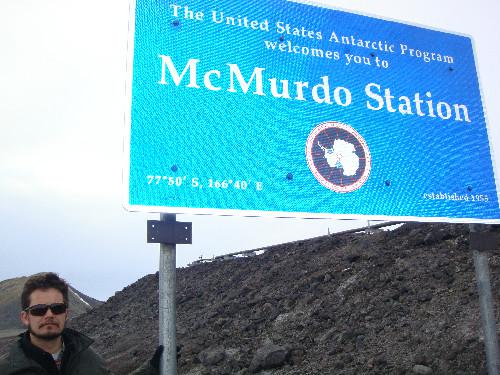
It goes like that. In a way, it’s refreshing to be in a place where being a playwright is exotic. But also, I am reminded in daily conversations of how few people go to the theater. McMurdo is full of world travelers, adventurers, athletes, scientists, artists, and anyone else you can imagine (one of my supervisors is a former Olympic bobsledder)—and still, very few of the people I’ve met here go to the theater. Even more scarce is anyone having any knowledge of new plays. I spoke to a talented illustrator from Seattle (a cook here) who said she saw an awesome play last year about collecting stamps. “Mauritius?” I asked. “That’s it,” she said. She was the only person I met here who had seen a play by a living playwright. I know the audience for theater and new plays is limited, but I didn’t realize just how flat-out obscure my profession is. Playwrights reading this—if you ever feel like there are a million of us out there—just ask yourself this: how many people do you personally know who have been to Antarctica? Okay, whatever that number is—that’s how many playwrights a normal person knows.
For the last two months, I’ve been working as a janitor at McMurdo. I work ten-hour days, six days a week mopping floors, vacuuming, scrubbing toilets, and doing countless random cleaning tasks in the driest, coldest, windiest, emptiest place on earth. One day, I worked in the store cleaning up cans of Orange Crush that exploded. As I wiped sticky goo off the couple hundred cans that didn’t blow up and could still be sold, I wondered, “What the hell am I doing here? What good is a playwright in Antarctica?” I mean, I was being paid to clean up cans of Orange Crush. I would never be paid to be a playwright here. Also, why is there Orange Crush in Antarctica? Are clean cans of Orange Crush more important than plays? At the bottom of the world, where everything is devoted to science and survival, never before has being a playwright seemed so ridiculous and irrelevant—and never before has it felt so necessary.
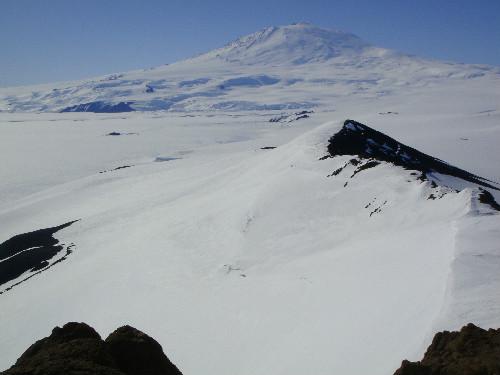
I’ve always looked at the bottom of the globe and wondered what life is like in Antarctica. I haven’t been disappointed. Every single day, something new blows my mind. McMurdo is a fascinating combination of breath-taking scenery, state-of-the-art science laboratory, self-sufficient town, freshman dorm, and Mardi Gras. Two months ago, I had never met a single soul on this station. Now, many of them are my friends. But who am I here? How different are we all from who we are back home? I live in small room with four other men, ranging in age from twenty-four to fifty-four. Two are ex-military and they sometimes talk about their experiences in Iraq. One of them lived two blocks away from me in Minneapolis, but I’d never met him. Kevin, the carpenter/bodybuilder, always says, “Everyone here is running from something.” I don’t entirely agree with him, but I think it’s true for many. Since spouses, children, and pets aren’t allowed (unless they are a working member of the community), everyone here must be able to leave his or her life for several months. That, in itself, is interesting. Never before have I been with a group of people who have the same difficulty answering the question, “Where do you live?” I need to write a play about this place. I bet a thousand playwrights could research Antarctica or come here to work, and there would be enough material for thousands of plays. There are already several good ones out there.
Also, why is there Orange Crush in Antarctica? Are clean cans of Orange Crush more important than plays? At the bottom of the world, where everything is devoted to science and survival, never before has being a playwright seemed so ridiculous and irrelevant—and never before has it felt so necessary.
While it’s true that this is the driest, coldest, windiest, emptiest continent, McMurdo is the Miami of Antarctica. We’re on Ross Island, just off the coast of the mainland, and in the middle of the summer (December and January), it’s usually between fifteen and thirty degrees Fahrenheit. On New Year’s Eve, it was thirty-nine degrees and people were outside in shorts and t-shirts playing Ultimate Frisbee. (Only once did I have a frostbite scare—foolishly forgetting to wear gloves at Hut Point while taking pictures of Adélie penguins.) Also contributing to the South Beach feel is that, ironically, it’s crowded. There are over a thousand people here in the summer, making it the largest of the three science bases in the United States Antarctic Program (USAP). It can be nearly impossible to find any kind of privacy. An Air National Guard LC-130 pilot summed up McMurdo best: “There’s one of everything, two of nothing, and three bars.” (For the record, there are two ATMs, but the statement holds because I’ve never seen them both working at the same time.) The station supports science in the Ross Sea region, the South Pole, and at the numerous field camps around the continent. Many of the projects are related to climate change and how global warming effects everything from glaciers to the ozone to algae.
A playwright, or any kind of artist, does a lot of good down here—as long as he or she agrees to do something other than art for sixty hours a week. At McMurdo, everyone must perform a necessary logistical task to keep the town running and the inhabitants alive. We don’t need to see a performance at 8 p.m. We need to eat. We need the buildings heated. With so many people in such a small space, if the janitors don’t frequently clean the toilets and showers, it’s a health hazard. At an isolated station of a thousand people, it’s easy to see the importance of each member’s contribution. In a city of millions, doing Excel spreadsheet after Excel spreadsheet at a random temp job, it feels valid to ask, “Why can’t I make a living wage as a playwright? Isn’t art more valuable than this?” But here, that question is ridiculous. More than anywhere I’ve ever lived, it’s easy to see why no one is paid to be an artist. (In terms of the Orange Crush, that was a one-time, three-hour gig—usually, I’ve got the gloves on and I’m scrubbing the porcelain.)
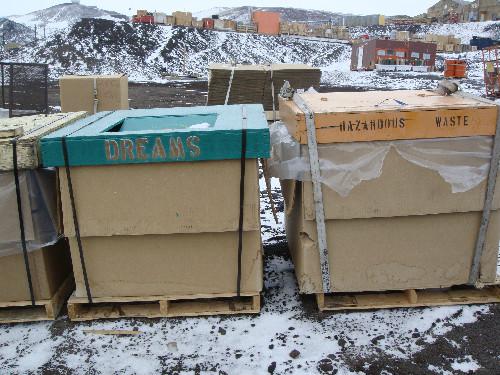
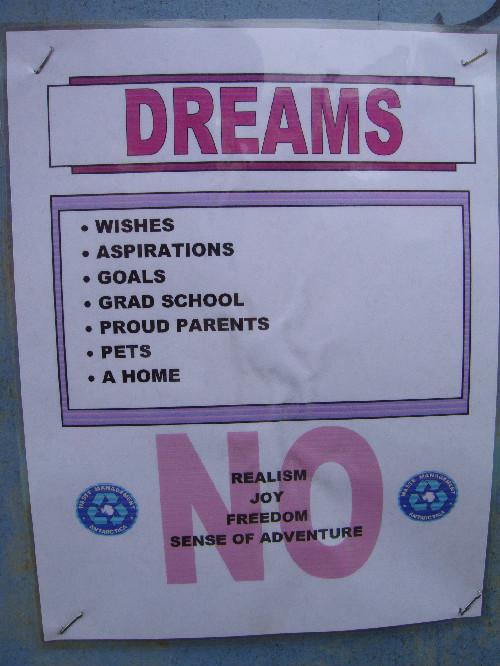
Despite everyone working sixty hours a week doing something that isn’t art—art, of course, flourishes at McMurdo. The beauty and strangeness of the surrounding world, the twenty-four hours of sunlight, and the bizarre social environment provide a constant inspiration for short films, illustrations, paintings, crafts, photography, and talent shows. Even sign making is an art here. Humorous signs are posted everywhere by everyone. For example, the wasties (the fearless people who process the trash) have created a few joke trash bins to go alongside the real trash bins. Next to food waste, aluminum cans, glass, or cardboard bins, you might find a trash bin labeled “dignity.” Other fake bins include “urine-soaked pants,” “romance novels,” “glitter,” or my favorite, “dreams.” However, live music is most cherished. Bands are formed for a single show, others have been together for multiple seasons. If we didn’t have live music to dance and unwind to, I think a sizable percentage of the population would lose their minds. If someone sings or plays an instrument, it will be discovered and exploited for the good of the community. And in a way, that has happened to me. I have been overwhelmed by the McMurdo community’s support and interest in what I do. People always ask me what I’m going to write about Antarctica, what I find strange and interesting here. People ask to read my work. I will leave McMurdo with the sense that the community truly wants me to write a play about our lives here.
Throughout the process of applying, doing numerous medical tests to be deemed physically qualified, being hired as an alternate and on call for five months, not knowing if I’d get to come, and then ultimately, landing here on December 12—I often wondered if I was insane for wanting to come here. But a serendipitous thing happened my first week at McMurdo that let me know this is where I’m supposed to be. August Wilson is my favorite playwright and I’ve always wanted to reread The Century Cycle in the order he wrote them. So I brought all ten plays with me to the Ice. My second day here, I went to the library. As I started to read Jitney, I looked up on the shelf and saw a collection of ten-minute plays called Take Ten. I flipped through it and found it contained a short gem of a play by my favorite playwright. I hadn’t heard of it before. It’s the only August Wilson play in the McMurdo Library. It’s called The Janitor.
- McMurdo Station, February 17, 2012.


Comments
The article is just the start of the conversation—we want to know what you think about this subject, too! HowlRound is a space for knowledge-sharing, and we welcome spirited, thoughtful, and on-topic dialogue. Find our full comments policy here.
Just found your post while researching on applying for library positions in Antarctica. In any case, your article is simply exquisite and gives a more humane vision of McMurdo than I could have possibly found anywhere else... I'm glad the library is helping your stay there... ;)
Fantastic Mat, thank you very much for sending. I sincerely hope I can see this play, plus others you have written.
McMurdo Matt
I am a fellow playwright and lover of August Wilson plays. I think our man Wilson would appreciate your adventure, not just into Antarctica, but into the everyday work and operation of a community. Giving a voice to the drama, humor, and dreams (trash worthy and otherwise) among those daily tasks is one (of many) of the reasons I love Wilson's work. I was very touched by your post. Best of luck to you!
I am fascinated by your blog! It is so cool that playwrights really ARE everywhere...even Antarctica! LOVE the trash bin for dreams...Please write those million plays...they are bound to be unique and wondrous. from another playwright in the far off land of OHIO.
Immersed in stories of the "Poles" as we speak and found this delightful. The sense of a job that truly is necessary... with bins left out for dreams. Contrary and not.
Jessie passed this post along to me...what a wonderful adventure - thanks for sharing! I love how the human condition is sort of condensed there and McMurdo becomes a perfect microcosm for the role of art in general.
Totally delightful. The joke waste bins are wonderfully funny. I look forward to see what you create from/with/within your experiences!
Hey Mat, Where you are is where you're supposed to be. Thanks for a nice read.
Warren
Nice one, Mat! I look forward to reading more from you. Hope you are well, and thanks for passing this along to me!
Mat-- This is the most exciting toilet-scrubbing job ever! Thanks for sharing. I can't wait to see what you end up writing about when you make it back stateside.
Awesome work, Smart! We reposted this to the LiveWire page. We can't wait to see what play is born from your experience!
Great read my friend!!! Thank you for sharing this.
Encounters at the End of the World, by Werner Herzog. A wonderful film about his brief stay at McMurdo and the surrounding area. Can't wait to read a play about it.
Such a good reminder that we are ALL art-makers, and about why art exists in the first place -- to allow for moments of collective release, to keep us from going crazy, to embrace the fact that we ARE crazy...
It's easy to forget, in a city of huge institutions and well-kept gates, how democratic art can be.
I have always, always wanted to check out Antarctica. Hope to hear more about it from you here, because my opportunity to leave my life for several months is years in the future (I have a first-grader).
Mat! I saw this because someone had posted it on facebook somewhere. Thank you for this post. I think you were the only other person I met on the ice who (perhaps masochistically) tries to eke out a living in a creative field, and thus spent their Antarctic sojourn mulling over the objective, pragmatic value of the arts. I've definitely been wrestling with what to do with all the crazy material I gathered down there, and what I'm going to make about it now that I'm back. Anyways, thank you for this post, and I look forward to eventually seeing the play that comes out of your time at McMurdo.
I love this! Thank you for sharing the article. I'm also writing about (and obsessed by) Antarctica, and this is such a wonderful, inspiring note from the field. Thanks for sharing your adventure, Mat!
~Ellen