

When There's a Reason to Rewrite
During our first workshop for The Luck of the Irish, at the Huntington, we had a winter storm. I think it did everything: rain, snow, slush, ice. It was the second or third day of our work week and I didn’t know the director, Melia Bensussen, very well yet, what I did know was that I was to be in rehearsal all day, there was no food in my house because I had planned to go shopping before the storm but didn’t, and now my kids would be at home with no food and I would be at rehearsal like the crap mother I knew deep down I must be. Akin to Anne Sexton. Only worse because what kind of mother doesn’t feed her kids while working on her art? Over phone calls and texts my husband said he would procure food. Over subsequent calls and texts it became clear that instead of bags of groceries my husband had procured several boxes of Lean Cuisine from the nearby Rite Aid. To say that I flipped out would be an understatement. And while this was a less than pretty moment in my life as a writing person who is also a parent, it could also be considered one of the first moments when the beginnings of a short hand developed between Melia and me that we would be able to use as we worked together on Luck.
When Luck first began to form itself on the page, all I wanted it to be was a play full of short two person scenes that slowly culminated into a play. Kind of like, “Oh, wow, look two hours has gone by and there’s no arc but that’s okay because there’s fifties stuff in here and these are vignettes, right? So it’s okay there’s no arc! Right?” The feedback was, generally, the same: the fifties scenes worked but the modern day scenes somehow didn’t and the whole didn’t quite steam roll into a full feeling play. Hints were dropped that perhaps those modern day scenes could go, perhaps the play was two separate plays, really, and some cutting was in order. And my violent gut reaction—despite my play-nice-face and just take notes modus operandi—was no—that Hannah and Rich and Nessa belonged in there and could be, would be, just as poignant as the fifties stuff we salivate for on stage.
When a play bounces around for a few years, making the rounds on the desks of literary managers of various theaters, it becomes easy to second-guess your own work. By the time Luck reached this particular workshop, it was already four years old. While the Huntington had (thankfully) recommissioned it after its initial commissioning theater passed on it, I didn’t really believe the play was going to be produced anywhere at all. It was becoming expected in my life as a writer that my plays were readable but not producible, and I know that after several years of thinking this, it began to influence how I thought of rewrites. My husband calls me the Queen of Rewrites because I can often whip those mofos out very quickly and obediently. My slightly OCD tendencies mean I don’t usually rewrite one scene after a rehearsal and leave the little things for another day. Instead I rewrite starting from the top of the play every night. Not every page, obviously, or I’d end up with a huge mess every time. But certainly I comb through the play after notes and then rewrite and rewrite. For a while there, for a few years actually, I was definitely not rewriting for production, I was rewriting for development, and it was killing my love of my work. And if you’re writing it, you should love it. It can be ugly. It can be so painful it makes you angry, but you still need to love it on some level. And for a while there, I didn’t love my work because I was rewriting while taking a devilish ride on the hamster-wheel of development.
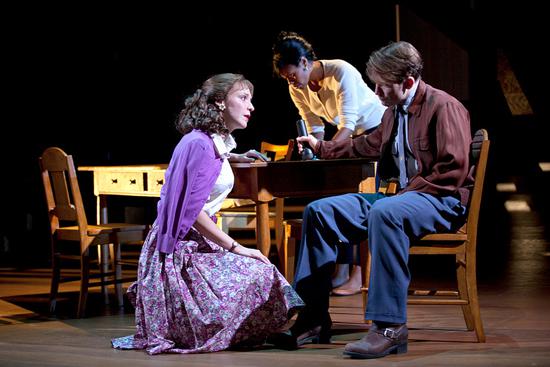
Image by T. Charles Erickson.
For a while there, for a few years actually, I was definitely not rewriting for production, I was rewriting for development, and it was killing my love of my work.
One experience that inherently changed my approach to rewriting was going to Sundance with a play that, for all intents and purposes, I’d hacked to death with a chainsaw; carving it out and serving it up at workshops around the country. While on that mountain with my one year old in tow, I spent several cell phone calls crying—yep crying—to my mother and husband that I knew the play needed a serious fucking from scratch overhaul, and I was not sure I could do it with this baby attached to me. But. I am not really a crier so I pulled myself together, thanked my Mormon babysitter profusely every day for making that part easier, and rewrote that sucker. “We watched you fall in love with your play again,” my director Rebecca Taichman said when it was over, and she was right. And I made a secret promise to myself that I would not write myself out of my play again—that I would find a way to stay connected to it, to keep loving it. And that’s the thing. It is always in your power to work on your play in a way that enables you to keep loving it. Always.
In the initial workshop it worked for me that Melia treated the play as if none of its parts needed to be silenced, while pushing me and the cast—and this play has been blessed with several casts that were really, really wonderful “in the room”—to refine what was already there. While I believe a writer needs to be prepared to fight for her work to be seen and heard, I don’t particularly like sitting in rehearsals and constantly defending my work. Refining, rewriting, sure, but I’ve had experiences where I felt as if I was more lawyer than writer in the room, and that did not produce a better draft, only a very skittish me on edge and cranky any time someone uttered the phrase “could we take a look at ____?”
What became clear as Melia and I continued to work together was that she got my Lean Cuisine moment in spades, and she inherently understood why Hannah’s present day anxieties were so strongly linked to the ghost buying of the Taylor’s house in 1958. From there I took many months to just think about the play, and rather than taking a chainsaw to my play, I was able, with the support of the Huntington, to have the time and space to rethink key elements of Luck. I was able to put a lot of “what ifs” into play in a way that was safe and completely supported by Peter and Lisa and Charles and Bevin (so many ands, but those are some talented peoples that make up the Huntington). What if the play wasn’t meant to be small scenes but was meant to have the kind of epic scope that results, yes, into a full-fledged play? What if the confusion of the modern day scenes is just as poignant as the seeming-nostalgia of the 1958 scenes? What if, what if, for a good many months, and I was supported in my need to take my time.
We had one last workshop before production and all this happy development time resulted in being able to start rehearsals with a draft with which we were confident, but which we also weren’t treating as so sacrosanct that it didn't need any more work.
In the end, I think what helped Luck immeasurably was that once in the actual room—after all that development—I was able to work with a host of artists and administrative types that each did their jobs impeccably well. No one tried to rewrite my play and I did not try to go build costumes or hang lights. I was expected to and given the time and space to tend the play.
After, of course, I got over having all that Lean Cuisine in my freezer.
Which is where it still is because that freak out was just as epic as The Luck of the Irish strives to be, and no one in my family dares touch it.


Comments
The article is just the start of the conversation—we want to know what you think about this subject, too! HowlRound is a space for knowledge-sharing, and we welcome spirited, thoughtful, and on-topic dialogue. Find our full comments policy here.
Beautiful piece, Kirsten! Can't wait to have you share more of your voice and thoughts on playwrights having homes at tomorrow morning's TCG Panel! And to trade much worse theatre-artist/parenting stories for years to come...!
This is phenomenal advice. I liked this post so much I ordered a copy of Milk Like Sugar. I look forward to hearing more of your voice.
Thank you!!!Just what I need to read right now!!
Thank you! Wonderful. Just wonderful. And you'll eat that LC one day.
"I made a secret promise to myself that I would not write myself out of my play again—that I would find a way to stay connected to it, to keep loving it."
Amen and brava!! Every time I have done what others tell me to do, or even suggest that I do, without making sure I love my play with it -- I always change it back.
Thank you for your inspiring article.
Great thoughts/confessions/ideas, Kristen!
This is so true: "When a play bounces around for a few years, making the rounds on the desks of literary managers of various theaters, it becomes easy to second-guess your own work."
I appreciate the perseverence (despite freak out) through this doubt and hard work by carrying the love of the work with you, the love of the play, the love of the story and the world you create. That love will last longer than even the success of the project.
To love!
Thank you Kirsten! This beautiful and funny article puts into words something I've been feeling and wondering about for a while. We must keep loving our work and sometimes it can be hard especially in the throes of the stop start of development. It's wonderful to hear about your experience at the Huntington.
Reminds me my favorite line from war horse - "I might hate you more, but I'll never love you less." It's complicated, isn't it? Thanks for these reflections.
Thank you for that quote: "It's always in your power to work on your play in a way that enables you to keep loving it." I learned this lesson hard in grad school and somehow afterwards figured out how to protect my work while in development. I thought of it as "protecting" but I like the idea of "loving" better. It's less defensive, more open, implies give and take.
Thanks for this, Kirsten. It's very heartening. As a writer who easily and quickly loses sight of the play I wanted to write in the face of trying to address every note, even, somehow, contradictory ones, it's nice to be reminded of this idea of loving your work and taking the time to find the play. Like you, I desperately want to "solve" the play every time I sit down to rewrite--I'm also impatient--and so I too comb through the whole thing after every workshop session, feeling it'd be wasting an opportunity not to do so. In the end, it sounds like the institutional support you had at the Huntington gave you the strength (and time) you needed. I do wonder how playwrights can withstand the urge to please everyone and solve the play as expediently as possible if/when that support isn't promised and it feels like each draft is a further audition...
Thank you for this, Kirsten. Wonderful and necessary testimony.