

A Lover's Guide to American Playwrights
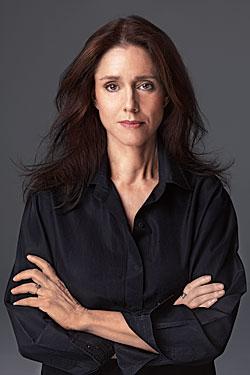
Julie Taymor
A Lover's Guide to American Playwrights is a regular column by Todd London. It is part of an ongoing series of tributes to contemporary playwrights. Mostly begun as speeches at New Dramatists—for career achievement awards, to mark the end of seven-year residencies, or, in a few cases, as eulogies—these portraits celebrate the body of work, lives, and singular gifts of those brave, ferocious, foolhardy souls of those who write plays for the American theater.
Julie Taymor
We have been told of a great fall, a great failure. Here is an American auteur director, the papers announce, making sense of that old phrase, “the daily bugle,” who has over-reached, plummeted from the sky, taking untold performers and investors with her. Sixty-five, then seventy million dollars, how many injuries, how many previews, closings, postponements—a sick fascination with a theater of hubris, as if failure in the theater were news, as if the greatest artists in history haven’t all produced colossal failures and embarrassments. As if money has never been wasted, artistic effort never misdirected.
I haven’t seen Spiderman yet. I’m waiting till it open-opens. But I have seen a lot of bad theater, a lot of shitty wasteful, expensive art, even by my favorite artists (of whom Julie Taymor is one). And I, like you, no doubt, have spent a lot of words on the importance of failure. I’ve demanded for playwrights what Zelda Fichandler called “the fifth freedom”—the freedom to fail. I’ve urged greater ambition, greater reach, bigger dreams. I’ve protested the lack of opportunities for women to work on the same scale as men, even men of lesser talent. And, personally, I find no pleasure in the lemming-like public spectacle surrounding Taymor’s production (which she co-authored with another writer I love, Glen Berger). In fact, I wish the newspapers and their reviewers (I can’t honor them with the term “critics,” even spit from the tongue) would look to themselves and watch their own comic book demise.
Anyway, I can’t and won’t forget that Julie Taymor is one of my contemporaries who have most inspired and delighted me. I can’t forget the challenge of her imagination, the categorical dare of her “authorship” as a director (which is why I’m including her in a series about playwrights). Now, it seems to me, is exactly the moment to celebrate her, to marvel (forgive the pun, please) at her vision and body of work. The challenge of her imagination: You can’t imagine Julie Taymor’s production. You can’t even pretend to get inside her head. There is no inevitable Julie Taymor staging. The script isn’t fully authored until she’s done with it. There are only possibilities, and they lie beyond our ability to imagine. Nobody can imagine the way she does.
How could you? You’d have to think in every dimension. You’d have to think words, painting, sculpture, space. You’d have to think music. You’d have to think bodies and wood, clay and silk, leather, shadow, light. You’d have to think the face masked. You’d have to think opera. You’d have to think cinema at its edges where film and theater meet. And you’d have to think dance, because everything in Taymorland dances: Roman soldiers in armor, Comedia clowns, hospital beds and men of bones. The world turns and we dance—across deserts and battlefields, under water, through gardens with singing apples rising 20 feet in the air. You’d have to imagine all this. And then you’d have to make it real. “Anything, everything is possible,” a character says in The Green Bird. And with Julie Taymor, it is.
More than all of this, more even than imagination, you’d have to think deeply, deeply through time, through the cultures of the earth. There’s another image I cherish, even though I never saw it, a different kind of workshop space. Julie Taymor, maybe twenty-one or twenty-two years old, living in a place called Peti Tenget in Bali with a theater company of her own, dancers, musicians and actors from Java, Bali, France, Germany. Hindus, Muslims, Christians. They share a deserted hotel, built on, and haunted by, a graveyard. No electricity or running water. They eat together on grass mats, and day after day for a year, eight or nine hours a day, they train each other—in Javanese dance, in Balinese dance, Lecoq mime, mask performance. Somehow they know to follow this young woman. Somehow she knows—has known since she went to Sri Lanka at fourteen and Paris at sixteen—that Boston isn’t enough, that this country isn’t the world.
How did she know that? What was she seeking? We talk about ambition in the context of “career,” but what is the ferocious ambition that would lead someone that young to places so unknown, exchanges so profound. What is the passionate world-view that actually encompasses the world? I took a walk with Julie once, one of the only times I’ve met her. We were at a retreat together north of the city sometime in the late ‘80s. I knew about her work, mostly from photos of her designs for King Stag and The Hagaddah and from friends at the now defunct Ark Theatre, where she did some of her earliest New York directing. Somehow she and I wound up driving to the Storm King sculpture park and walking the grounds together.
Soon after our walk I saw one of the most miraculous things I’ve ever seen in the theater—Juan Darien, the carnival mass she and Elliot Goldenthal wrote. There is no spoken dialogue in Juan Darien. The story’s told in music and imagery. It unfolds before you, the way dreams do, but the visual vernacular is South American, mural, carvings, myth. A jaguar becomes a boy. He begins as a rod-and-string puppet, transforms to a doll, becomes a Bunraku puppet, and, then, a flesh and blood boy, the only unmasked actor on stage. An entire village appears, inhabited by shadow puppets. It’s so small, so close, you feel you could hold it in your arms. We see a tiny classroom under a minute bell tower; there are hand-puppet students and a teacher nine feet tall, sporting five pairs of spectacles on his nose and hair made from the pages of an open book, which flap like crazy when he gets mad. A globe begins to glow and spin, and inside of it a flower blossoms, sprouting leaves.
In Juan Darien we watch transformation. Our cells vibrate. They are little mirrors, emulating what we see. We enter, moving inside a transforming world, and, so, we are transformed—by possibility, by endless life in intimate parade, by the reach of the artist’s imagining. Our souls vibrate. We reach, too. I take a walk with Julie Taymor in a sculpture park and then I encounter this. And so for twenty years, every time I’ve watched a production or movie of hers I’ve wondered, what did she see, walking that park? How did the landscape look to her? What did she make of the steel statues, or the stone figures, the shaped hills and dips of earth? What does Julie Taymor see?
There’s no end of astonishment in what she sees. Titus: A general pours sand into the soldier boots of his five dead sons. Sand that could be their ashes. Transposed Heads: Two young men in love with the same woman lop off their own heads. Their severed heads dance in the air, finally landing, attached to the wrong bodies. The Lion King: Giraffes lope across the stage—or are they men on stilts? Gazelles leap. The whole natural world, impossibly, fills the stage. The Green Bird flies up and descends as a man.
Her ability to craft what she sees is up to any miracle. Her solutions are never what we’d expect. How do you show boys dying in the marshes of Vietnam? Butoh dancers, women caked in white clay, fall on their backs on the surface of a lake, lifeless masks floating beside them. How do Frida Kahlo and Diego Rivera tour the New York City of the thirties? They stroll through a pop-up metropolis, made of postcards, a paper-doll world. You want the sun to rise on the Serengeti? Cut the sun from silk and raise it, strip by strip from the stage floor till it fills the upstage wall.
For all her gifts, at bottom, Julie Taymor is simply a great storyteller. Moment by moment, startling image by startling image, she never loses sight of the story. Break down her brilliant imagery and you’ll see the simplest of choices, all in service of story. One example: Frida Kahlo, stuck in America, is homesick. She looks out a window and what does she see? A painting of a dress on a clothesline, a painting of a dress the colors of Mexico. The painted dress begins to sway in the wind. It comes real. She is home.
For all her gifts, at bottom, Julie Taymor is simply a great storyteller. Moment by moment, startling image by startling image, she never loses sight of the story. Break down her brilliant imagery and you’ll see the simplest of choices
Whether it’s a tale of the humanity of the animal kingdom or of the bestial in us, Julie never loses sight of the human heart. I saw The Lion King a decade ago with my then five-year-old son. I remember the circles and the wildebeest stampede and the elephant in the audience. I remember the grassland headpieces. But what I remember most was my son turning to me when the King Mufasa died and, seeing the tears on my face, saying, “It’s sad when fathers die, isn’t it?”
This is what stories do: they reach to us, culture to culture, world to world. We sit in abandoned buildings and show each other what we know. We tell each other tales in dance and song, image and word. Stories are the world’s dreams, and Julie shows us those dreams, in images at once deeply familiar and shockingly new, images that, in John Lennon’s words, call us “on and on, across the universe.” You think you know the Beatles’ song “Let It Be”? Watch it sung by a young black boy with his back against the tire of a car, while Detroit riots around him. Hear it sung by mourners at the boy’s funeral. We know it and we hear it for the first time.
Back at the New Dramatists church, we have a black Underwood manual typewriter, circa 1945. It’s perched on the top shelf of our new play library. It’s hard to shake this iconic image. The playwright hunched over the black manual keyboard, banging out his play. The old fashioned dramatist. The cardigan sweater. The pipe. Julie Taymor is a different kind of author, whose methods are even more old fashioned than the Underwood. She reaches back centuries into the Japanese Noh Drama, rummages through the masks and lazzi of Commedia, draws on Indonesian shadow puppetry and Greek masked drama, Shamanic ritual and Indian classical dance. She is at once the most contemporary, experimental artist and the most ancient practitioner.
No one writes on that typewriter anymore. Today’s playwrights use laptops with wireless connections. Some think sound and light, projections. Some create through improvisation. Some direct their own work, stage their own extravaganzas, run their own companies, travel the world. Like Julie, they tap the ancient notion of dramatist and explode what we think of as new.
A confession: my faith in the theater is tenuous. It’s challenged every day. Sometimes I feel like I spend my life searching for the art and artists who will re-excite that shaky faith. I’ve found a place that does it, in an old Midtown church building surrounded by beautiful, ferocious people who are driven to reimagine the world. And I’ve found a few artists of my generation who continue to inspire me. I keep looking for those rare theater makers who can do what Peter Brook describes, mingling the rough, the holy, and the immediate: Who know and use the theater’s rough magic. Who touch the sacred. Who make the art alive, here, now.
At the end of Taymor’s The Tempest Helen Mirren, as Prospera, speaks Shakespeare’s words:
I have bedimm'd
The noontide sun, call'd forth the mutinous winds,
And 'twixt the green sea and the azured vault
Set roaring war…
The sorceress details the majestic fury of her sorcery:
…graves at my command
Have waked their sleepers, oped, and let 'em forth
By my so potent art.
But at the end of The Tempest, Prospera will break her staff and bury it in the earth. She will abjure her “rough magic.” Thankfully Taymor is a young magician with decades ahead and centuries behind her, from which to draw. She takes this globe and sets it spinning. It glows. She stands of the verge of places still uncharted, worlds we can’t possibly imagine. What does she see? I can’t wait to find out.
An ongoing series of tributes to contemporary playwrights.


Comments
The article is just the start of the conversation—we want to know what you think about this subject, too! HowlRound is a space for knowledge-sharing, and we welcome spirited, thoughtful, and on-topic dialogue. Find our full comments policy here.
Todd!
found you on the web -- Rodeo? South Pac? please write me back to say hello. glad to see that life worked out!
warm regards,
Tod (where's Stu Figa anyway?)
Julie Taymor was a Watson Fellow just after she graduated from college. You had to submit a proposal for travel and independent study outside of the US. Her proposal was to go to Bali. Some years before,in 1970,I was a Watson Fellow. At my interview, I was told that fellowships weren't being given to young women because it was thought that they would just marry and have babies and not contribute so much to society. I argued and argued that that was not true. My proposal was to study experimental theatre groups in England and Western Europe. At the Polish Embassy I was encouraged not to travel to see Growtoski since I was too pretty and would no doubt get in trouble. I admire Julie Taymor her courage at a young age. She was pretty. I admire the Watson Fellowsip that awarded her that time of grace.
Truly inspiring--both the article itself and the content. Thank you for this beautiful work of art. (And yes, I mean work of art.)
Thank you for this wonderfully written article. A piece of art in itself. I appreciate the larger view it takes, and the allowance for what we think of as failure as part of growth.
It seems humanity has always been attracted to spectacle, whether its ancient ritual forms of drama, the circus, the olimpics, or war. In some ways as a species we can be and are addicted to the wonder, the high, as well as the mystery of it. So undoubtedly spectacle is here to stay and will express itself in one way or another. The question, sourced by this article, that I end up contemplating is: To what purpose does the spectacle serve? Certainly Julie Taymor's THE LION KING and THE GREEN BIRD (the only two theatre pieces of hers I have seen) served in my opinion a large and worthy purpose. Both expanded and thrilled my mind, warmed my heart, and catapulted me out of my usual way of perceiving things. This allowed me to perceive in a new way, within a different framework while also being emotionally engaged. And THAT is certainly one of the challenging, exciting, and necessary gifts that theatre and other creative arts has to offer us.
What a beautiful article on the artist
Its interesting how we as a culture can exalt one another and in the same breath berate
Julie is an amazing talent and being
I am glad to see a person who is not afraid to create
How can you be an artist if you've never failed
Failing is required to succeed!
My colleague sent me to this posting. Thank you so much for looking at this with the clear, clean eye in a larger context. Why the world at large has been caught up in the tawdry broadway scandal you have made clear there is a bigger story here. A story about an American Director with many successes and her greatest achievement- her work has impacted and changed the American Theatre forever. Well said.
Yea, Todd, and bravo Julie Taymor, indeed a great director who's done so many things that changed us. She will be back soon.
The money isn't really wasted. Artists get paid. As for the money, the investors do it for the joy *and* the profit. They know it's risky.
Call it "failure," so be it, we all learn, and back we come straightaway with more ambitious work. It's worth it. There's always someone who wants to say something negative and maybe people to listen too. Don't let 'em stop you.
A beautiful piece. I wrote about how moving, complex, and original Julie Taymor's Spiderman was at the Guardian:
http://www.guardian.co.uk/s...
Sadly, she was not allowed to pursue her vision to its completion. A real loss I think.
Holy Crap...
self-serving agrandisement. Sel-pitiful pleadings. NYC school lucnch programs in fear of falling while 70 millions of bucks are loss on a Broadway stage. It's criminal. Even to dreamup and find financing for such an induged undertaking. Of course,I would probably feel differently if the money was blown on one of my shows. But it wasn't. POwerful friedns with powerful voices. Ther is no way to justify this travesty. It's America, the way we do things in a BIG way!
Wonderful choice to write about her in the company of playwrights. I wish more of us would recognize that directors can be authors, too; that a play is multi-authored.
Fantastic. She is a great inspiration to me, too. Thank you.