

The Bounty of Big Institutions and the Glory of Grass Roots
Martha Lavey, the artistic director of Steppenwolf Theatre Company, called me on my cell when I was standing next to a borrowed white pickup truck double-parked on First Avenue on the Lower East Side of Manhattan. She was calling to tell me that Steppenwolf would open their next season with my play Detroit—I’d heard this news from P. Carl a few days before, but Martha was calling to make it official. I was thrilled, I thanked her, I hung up my phone, pulled another 3-foot x 6-foot red wrestling mat out of the truck, and handed it to two of the dancers who were performing in my show at PS122 that night. I knew I also needed to send my intern to buy four bags of marshmallows, drop off press kits at the box office and, oh right, re-park my friend Charles’s truck before curtain. Crazy. And also thrilling.
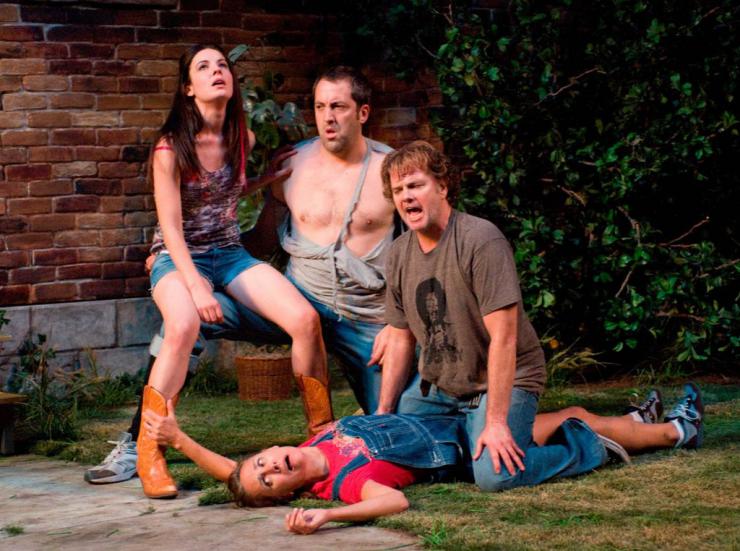
Since then, Detroit enjoyed an awesome run at Steppenwolf, supported by a six-figure budget, a crew of at least forty with audiences numbering in the thousands. Three weeks after it closed, my husband Brendan Connelly (of Theater of a Two-Headed Calf) and I self-produced our new mini-musical in the New Orleans Fringe Festival, in a converted storefront called Party World. The budget was exactly $1,812. We oversold two of our three performances in our 80-seat house. We grossed $1,072 at the box office.
I’m sure some people think I am crazy for moving back and forth between these two worlds. Once I’ve gotten in the door of a theatre like Steppenwolf, shouldn’t I be putting all my effort into getting more gigs like that? Well, I won’t turn them down, but this year has made me realize that both worlds—the grass roots and the big institutions—have been a crucial part of my past as a playwright, and both are essential if I am to lead a healthy and productive life as a playwright into the future.
Why do I love the grass roots? Those of you who know me already know the answer to this question. I “grew up” making theatre in alleyways in Austin, parking lots in Minneapolis, under bridges in Portland, Oregon, and in movie-palace-turned-rave-clubs in New Orleans. These experiences usually began with me and a collaborator (usually Katie Pearl) sitting in a park or a coffee shop or the cold floor of an empty dress shop that had been given to us and saying “So. What do we want to do?” We could imagine our project from the ground up, no guidelines, no expectations, no limitations (except for maybe a $200 budget). The budget wasn’t an issue though: since we started with nothing, the stakes were only as high as our own aesthetic ambitions. We could do anything: experiment with form, language, audience interaction, and so on.
Working on low-budget, grass roots theatre has made me a more flexible artist.
When P. Carl first lured me into the world of Steppenwolf with a commission, I was skeptical. I had avoided big institutions my entire career. I had great admiration for Steppenwolf as a trailblazer, but their push-it-to-the-edge naturalism seemed a strange match for my angular, more stylized writer’s voice. But I said yes, mostly because I have infinite trust in Carl, and also because hell, I needed the dough.
The road to Detroit being produced was faster than either of us could have imagined: Detroit was not my commission, but a play I had just finished, and Steppenwolf read it and pretty much decided to produce it instantly. There was part of me that was like “Well, sh**. I’m going to get eaten alive by this institutional beast!” I quickly learned, however, that I was being ruled by my assumptions about what a “big institution” was. In my first few visits to Steppenwolf to workshop Detroit, I was amazed by the way they engaged with their audiences—there are audience discussions after each show—and how they involved me in every step of the process. They also seemed eager to bring up my more experimental, interdisciplinary work in video and program interviews. In short, Steppenwolf seemed ready for dialogue, and interested in who I was as an artist. All I had to do was be me, as clearly as possible.
Working on low-budget, grass-roots theater has taught me what it means to be a part of a community: to ask for help, to give help, to never feel alone and powerless.
Now I’m not saying that working on my first show with Steppenwolf was a total breeze. It was a new relationship with a theatre that has been around a long time. I had a lot to learn about when was the best time to ask a question, and who to ask it to. And there were times when I felt intimidated by the experience and clout of many people who work there. But I always felt empowered to question and participate in everything from marketing to dramaturgy to set design. This was in part because I was invited, and in part because I had such a strong background in knowing what it takes to collaborate and get the job done from the ground up.
Working on low-budget, grass roots theatre has taught me how to ask the right questions and clearly state my needs when working in a larger institution.
When my show with Brendan, Du Fu, Mississippi was accepted to the New Orleans Fringe Festival, we were thrilled and also a bit daunted: it had been three years since I had worked in New Orleans, and I needed help on all fronts. I didn’t want to seem like an outsider barreling into a scene I hadn’t been a part of for a while. I started by asking my dear friends at ArtSpot Productions for help—ArtSpot in many ways started the experimental/interdisciplinary scene in New Orleans fifteen years ago, and have developed a large and faithful following. One of their ensemble members wound up being in the show; another agreed to design our set; both were working for a nominal artist’s fee and an even more modest set budget. Another friend from New Orleans Mondo Bizarro joined the cast. Both companies helped with marketing and promotion and Mondo wound up saving the day by helping us document the show on video. When I couldn’t find a costume designer who did I turn to? Mom, of course. She made Christmas pajamas for me when I was five, why not sew costumes now that I’m forty? Throughout the whole process: a feeling of effortlessness, of resources existing to be shared, of a community of artists who know what it takes to make a thing of beauty.
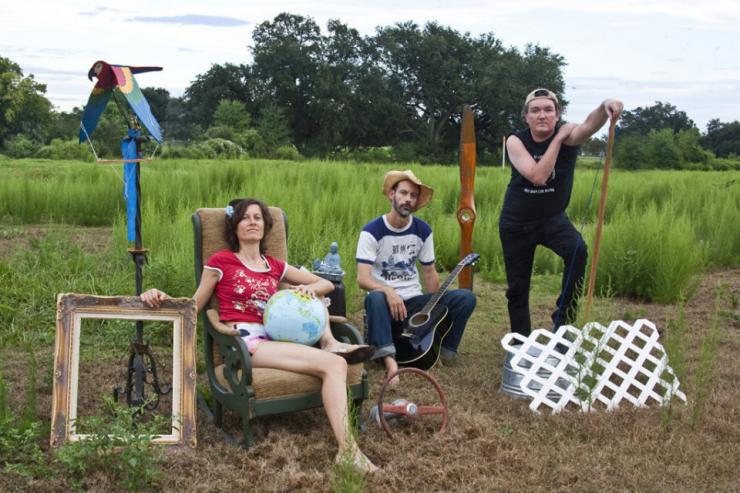
A good example of the New Orleans team effort (which, like almost everything in that town, somehow manages to feel like a party): I hired my friend Zack Smith to do a photo shoot for our promotion. We met Zack at his apartment in the Bywater—he knew like, two sentences about the show. He stood on his front porch and said, “Okay, give me the scoop.” I told him it was a show that transported 8th century Chinese poetry to a front porch in contemporary Mississippi—think front porch Buddhism, Zen mixed with Appalachian folk. “I got it,” he said. “Let’s throw some things in my truck.” We set to work—me, Brendan, the cast—gathering up old rocking chairs, cinderblocks, toy parrot puppets, statues of the Buddha, bamboo and more, and tossing it into the bed of his pickup truck. He told us to meet him at the abandoned golf course at City Park—where ArtSpot had recently put on their hit show Loup Garou. We drove our cars out on to the middle of the overgrown green, set up our props, and started shooting. An hour later, we were packing up with a ton of amazing shots to use.
Something that informal yet effective could have never happened at Steppenwolf. It would have taken countless emails, a props budget, permits to shoot on city property, perhaps extra money to pay for the actors’ time. At the grass roots level, there’s more room for improvisation. And perhaps, for the sheer enjoyment of pulling something off beautifully out of thin air.
Working on low-budget, grass-roots theatre has taught me what it means to be a part of a community: to ask for help, to give help, to never feel alone and powerless.
The trick: in general, I would say that “grassroots” and “big institution” theatre people stay entrenched in one world. Those working with few resources can get burnt out and feel resentful of the theatre people with money. Those working in the big institutions can get burnt out and look down on the “storefront experiments” of the smaller companies. And how on earth would you ever find the time to work in both worlds anyway? A theatre career of any sort takes every ounce of your time and attention, right?
I see progress—theatres like Steppenwolf are co-producing shows with smaller companies, which naturally mixes audiences and brings artists from these different worlds together. But the divide is still huge. I wonder if playwrights are the artists who can truly bridge the gap? Who can move between both worlds and perhaps be secret ambassadors for each way of doing things? It’s clear to me that I need both worlds in order to survive aesthetically, spiritually, and financially. Do other playwrights feel the same way? Is there value in trying to encourage these two worlds to collaborate more fully? Or are the lines too firmly drawn, the categories too firmly entrenched? Playwrights, what are your thoughts?


Comments
The article is just the start of the conversation—we want to know what you think about this subject, too! HowlRound is a space for knowledge-sharing, and we welcome spirited, thoughtful, and on-topic dialogue. Find our full comments policy here.
Thanks for writing about these experiences, Lisa. I'm really excited by/about all the things you are doing.
big hugs,
ROMERO
Thanks for this great article! As a playwright & producer who also moves back and forth between the two, it seems to me that playwrights are in a position to be those ambassadors - so many of us do go back and forth just in order to get work up and out in the world.
The trick, I think, is in figuring out how institutional theaters can take advantage of the terrific resource they have when a playwright like yourself walks in the door (it sounds like Steppenwolf did that). This takes some flexibility on the part of that institution and a realization that brining in a playwright is more than just bringing in a text - it's bringing in (potentially) a new way of communicating and connecting with the work and with the audience. And of course, it's on us as playwrights to figure out how to be a part of the bigger conversation at a theater: knowing what we bring beyond the words on the page.
Perhaps I'm prejudice when it comes to what grassroots theaters can gain from the institutions in - but my own feeling is that too many small theaters try to take more than they should from the institutional examples. The strongest grassroots companies - I think - take their lead from their community and their mission and don't assume that the institutional model is one to aspire to. But like I say, that may be my own beef.
Yes! I think maybe the best future for playwrights in America is in adaptability and leadership. The tide is turning on the sorry state we got ourselves into, relying on institutions that don't really understand what we do to "help" us to do it, abdicating our responsibility as artists in exchange for that greatly desired object, production (and often just for a reading). Self-production is a heroic endeavor not everyone is up to the challenge of (I burnt out on it decades ago but I miss the autonomy and have been mulling it over!) but creative partnerships can be forged everywhere. I've been thinking about this subject on a more modest scale, having had my first Off B'way production after mostly working with little theaters; the push is on to go for the "big" productions, but I don't see any need to give up the "small" ones in the process, and I'm getting a sense of the different advantages of both, and also of the ways they're the same. With bigger budget institutions, the greater resources are cool and there are wonderful people to work with there too, but it's easy to feel like an outsider as the playwright coming in, trying to feel out this foreign culture, as you talked about in your post, sniffing out the unspoken rules, figuring out how to work within it. Sometimes by the time you've found your way, it's nearly over. What I love about working with small companies is that I can become part of their culture quickly, be a full collaborator in a genuine hands-on way. I love hanging out till midnight on tech week helping to paint the set or distress the costumes, a part of all the ad hoc but crucial little conversations and creative leaps that happen on the fly. So yeah, I think resisting the idea that the ideal is a steady march toward larger theaters, and feeling free to roam among all the possibilities - responsive larger theaters, brilliant small companies, cooperations such as David Loehr above wrote about, self-production - with playwrights finding ways to create and develop situations for the work, rather than passively accepting the status quo, is smart and good. Thank you, Lisa!
Beautiful post. Thank you.
I firmly believe these two worlds can and should collaborate more fully, whether by working together intimately on specific projects or by something as simple as larger theaters opening their spaces and hosting smaller companies as resident companies year-round.
Such a cooperative effort--not a firm collaboration but allowing for that possibility--would, I think, benefit both the major theater companies and the grassroots ones. And maybe, in a world where such partnerships flourished, that kind of improvisational attitude might be possible at a Steppenwolf or an Actors Theatre. At some point, everyone who works in those buildings got bitten by the same bug as those of us playing in the grassroots. Given the opportunity, I'd like to think some of those organizations would take a chance and see what happens.
What a great reminder, Lisa. Thank you. I'm not sure the lines are too firmly drawn by the institutions, but by social status. Sometimes I feel like I "ought" to be getting my work into larger institutions, or that I'm somehow "missing" a chance at something as a writer. I think you're right, they are not mutually exclusive. Why can't writers do both? I think it's really easy to lose the right measuring stick for your work -- to forget who you're doing it for. It's silly, but I'll admit I think about it.
Thanks so much for this wonderful post, Lisa. As a young playwright, I'm in the process of navigating how to build my life (as opposed to just my career) as an artist. Playwrights like you, who are unafraid to move between the two worlds you describe, are proving a major inspiration as I think about my artistic life. Reading this article has been incredibly affirming for me. To know that other artists are doing the same balancing act I hope to do, and are succeeding at it, gives me hope.
I love this article. Thanks for writing it. I think one of the most important things it states implicitly is that both the fringe or avant-garde and the mainstream are both vital to the enrichment of the form. I don't know of a better illustration of the way we all need each other.
Another advantage of working on the grassroots end: my role as a writer is often more fluid than in more traditional theatrical settings. Meaning, I can be a "writer" who writes original text, but may also draw on found text and other source materials, as the form demands.
Beautiful, Lisa. Thank you for writing that.
I believe that for playwrights to fulfill that secret embassy, the whole company (small or large) has to respond to the playwright as a leader. It can be dangerously easy for a company to think that it's going to produce "for" the playwright, or even to assume that the playwright doesn't know how to produce.
The playwright as leader in a production context is an old practice that fell out of favor for a long while and seems to be coming around again, which I am delighted to see.
I'm not a playwright, but it seems from the outside that if you can keep those extremes of big and little in a healthy and delicate balance (as you describe doing) you will have fully succeeded as an artist. A great piece.