

Theater Geek
My tray is full and I’m standing in the cafeteria. I’m imagining that everyone is looking at me but fearing that I’m invisible. I don’t know where to sit.
I find high school dramas of all kinds generally irresistible. Irreconcilable crushes, the discovery of previously latent powers, the unquestioned belief in the power of idealism, quarterbacks and band geeks—I can’t get enough.
The television series Glee, especially, speaks to me. Likely this attraction is twofold. First, I’m in the field. I’m a professional theater maker, deling in spectacle and acting and singing and movement for a living. More pointedly though, Glee replays a deep insecurity in me—a perennial conflict between the artist and the jock, the theatermaker and the social player. Unlike most in my profession, my interest in the arts developed relatively late in life. I was not a theater guy in middle school or high school when the arts were considered un-cool, so I never experienced the social stigma that accompanies a young artist and sits at the center of many a Glee episode. I became an artist in college, perhaps not coincidentally just as the disgrace generally attached to the pursuit faded.
I’m in my forties now and, unbelievably, this continues to be a source of tension for me. I feel like I got away with something. I didn’t suffer that rite of passage. I was never teased or punched, never had a "slushy" thrown in my face or down my shirt, and I feel like a fake. I didn’t earn the right to call myself an artist and maybe that means I’m not one. I fear I somehow chose this pursuit for all the wrong reasons, not for the deep undeniable love of a real artist, but for some more petty and self-absorbed reason.
It’s a club, I realize. We, who have found a way to make theater our primary endeavor, are all members of the club.
I know it’s ridiculous, but it occupies me nonetheless. I want to be a theater guy, but I don’t want to be a theater guy. Even today, I alternate between admiring thespians for their faith in the discipline and wanting to throw them against a locker. The tension lives within my work and my ambition. Though I have had many great experiences in the theater both as an artist and as an audience member, I rarely create work for theaters because I just can’t get myself to believe in it. I love the silence and smell of an auditorium; I love the control it provides and the glory that may accompany it. But, despite myself, I can’t get past what I see as its social futility. Inevitably, by the time I’ve finished putting a piece up, before the reviews even land, I can’t wait to get out of there and make something in a public space, with its chaos and uncontrollable vitality.
Case and point: a couple of years ago I finally convinced Redmoon, the theater company that I helped to found and have led for almost twenty years, to drop the word “Theater” from its title. The word created a sense of expectations and artistic alignments that seemed neither accurate nor particularly helpful. But I still call it a “the theater company I helped to found.”
So, tray in hand, looking over a smattering of tables packed with professional theatermakers of all stripes, I found myself revisiting my high school insecurities with an undeniable force. I had accepted an invitation to a convening of artistic directors, playwrights, grantors, and heads of theater service agencies to be held in Washington, DC. It was an important gathering of big wigs from all over the country. It was live-streamed with two video cameras and area mikes around the speakers’ table. There were photographers shooting the hot moments. Four or five bloggers tweeted and posted thoughts and reflections to a “third circle” of participants in the blogosphere.
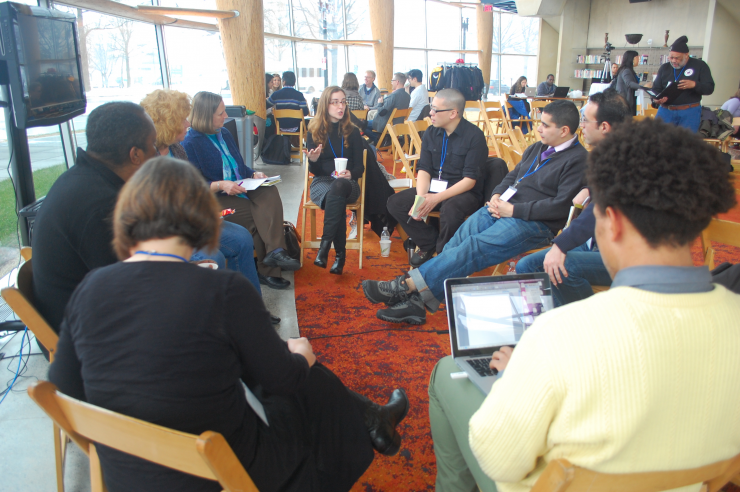
The event opened with Rocco Landesman, the chairman of the NEA in dialogue with Diane Ragsdale, a former grants officer from the Andrew W. Mellon Foundation, who, along with the Doris Duke Charitable Foundation, made the plentiful grants that put this convening and all its preceding activity into motion (which included prior, smaller, convenings around such broad issues as diversity, devising, and black playwrights, and a whole lot of research projects and practical engagements).
Mr. Landesman put forward a simple analysis of the field. He made two points.
His first point was a historical one. In the late sixties a few broad thinking theatermakers argued for the importance of creating a theater protected from the crass concerns of the marketplace. As a counterculture movement took hold in the United States of America, it was important to American culture that the theater have the ability to be aesthetically and socially challenging. That ability could only be assured by some degree of independence from the market. Funders were persuaded and mechanisms were put into place to support the regional theater movement. Since that time, Mr. Landesman said, there has been a slow corrosion of this countercultural mission. It has gone so far, he insisted, that the very same theaters that once served as venues for alternative voices were now as involved in cultivating Broadway bound productions as anything else. Once created for the express purpose of sitting outside the reach of commercial theater, these theaters now walk with commercial houses hand in hand.
His second point was a market analysis of the field: theater is in short demand and long on supply. More theater is being made than people are interested in seeing. Non-profit theaters are popping up like weeds in a field and sustained, in part, by a series of small grants—just enough to keep them alive. Few, including the most successful regional theaters, are able to support theater practitioners with a living wage. There are nearly six million arts workers in the United States and only about a third of those are artists. The lack of professional careers in the arts is not evident in the ever increasing number of training programs that pump more practitioners into a field unable to sustain them—most of whom, no one pointed out but many surely thought, will stop making theater in a short time and start new training programs themselves.
The convening was off to a great start. At most of these conferences, this is the proverbial elephant in the room. It is this massive and definitive reality around which everyone navigates but refuses to address.
Now it was named. It was out in the open, noted, tagged, and declared. Having seen our difficult market position and declining relevance, having acknowledged our discontented practitioners and deeply entrenched systems, we could now turn to finding new ways of working and being in the world. Now we could turn our attention to the real issues that would help us create a vital and living theater.
Except we didn’t. Mostly the conference proceeded as if Rocco Landesman hadn’t spoken at all. We talked about new plays and playwrights, about how the internet could be used as a common resource for those looking to develop new work.
What was I doing here? This wasn’t for me. Redmoon doesn’t develop plays. Mostly I work in public places, combining spectacle and deconstructed visual narrative. Plays—words on a page that will later be translated to a stage in a theater with audiences in seats—this is not what I do.
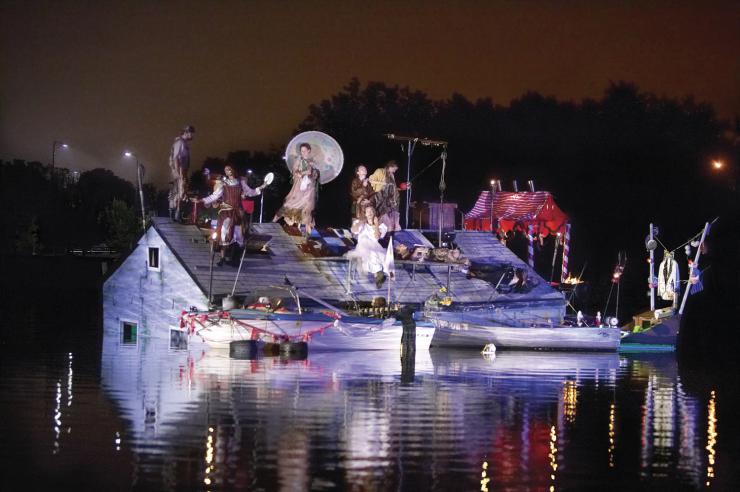
I reminded myself that over the years one or another of my shows was traditional enough to draw interest from the national theater scene. I’ve had a couple of positive New York Times reviews and, encouraged by them and their prospects, have knocked on a few doors, met some of these people, had good talks.
So I convinced myself I had a place at this table, that I wouldn’t have been invited if they didn’t value what I did and had to say. I had worked up just enough expectation to have it dashed when the moderator and host, a man with a piercing voice and a well-demonstrated facility with names and credentials and timelines, turned to me and didn’t know my name. To be more precise, he wasn’t sure of my name. He had gotten it right, but then, when I looked at him so blankly, I shook his confidence.
No doubt it was the look on my face that confused him.
Let me explain. The sessions had been organized around themes. The participants explored each theme in two different settings. The first consisted of two concentric circles. The inner circle was around a conference table situated with microphones so that the intimate conversation of its eight members could be shared to the outer circle of ninety or so. After this first exploration, the entire group was divided into smaller groups of eight for breakout sessions in which the topic could be explored further.
I was called to the center table to converse about the subject of artists and institutions. The question that the moderator had put forth, to get the discussion rolling, was, “How are artists doing with institutions? The typical understanding of the artist is that they sit on the margins. Are artists feeling alienated?”
I now realize that he had turned to me out of courtesy. The conversation had been going for some time and most everyone around the circle had spoken, but I had not. I was dumbstruck. I couldn’t understand what was being said. More horrifyingly, I thought that maybe I understood perfectly well what was being said. In either case, I froze.
Were artists alienated? Are they on the margins? The answer offered up by the arts administrators of some of the largest regional theaters in the country was that artists didn’t appear to be very alienated, or at least not the artists working with their institutions. Of course resources are limited they pointed out, so it depends on the artist. There were others at the table, two playwrights, a couple of funders I think. But we all fell in line. What followed were some tips on how to make artists feel more at home: pick them up from the airport, involve them in conversations about how their work will be represented, etc.
Huh? Are those of us around this table so enfranchised that we don’t know what alienation is? And, frankly, isn’t a feeling of alienation practically a requirement of the job? Artists who work with us, the self-proclaimed “king-makers,” seem really happy and well resourced?
These are smart people. Not only are they articulate, personable, and charming, but they are smart people. A career in the arts, whether administrative or artistic, does not happen easily. I’ve met a whole lot of idiots in my life, plenty of them successful, but I don’t think I’ve ever met an idiot who figured out how to succeed in the arts. Yet by any account they were giving a non-answer, no matter how eloquently delivered.
Of course it’s a question of resources.
* * *
In the weeks that followed the convening, Chairman Landesman’s comments created quite a stir. First they lit up the blogosphere. They were covered in the Washington Post. The Chair of the NEA believes there is too much art? Should marketplace logic be applied to the arts? Who does he think should be eliminated? Is it the big theaters that have lost sight of their countercultural mission? Or should there be a thinning of the myriad of little theaters struggling to find a market and oftentimes a voice?
The title of the entire conference was “From Scarcity to Abundance.” The title was supposedly a reference to a noticeable and determined increase in the resources, opportunities, and funding available to those seeking to generate new work—be they artists, producers, or presenters—the field was newly rich with opportunity. I cannot comment on the truth of this hopeful assertion. Redmoon’s work is generated from a very different non-profit business model and is not really part of the theater industry’s economy. We don’t do a subscription series, nor does ticket revenue figure heavily into our budget. Moreover, I’m not involved in the commerce of new plays. Our work is devised, it’s created collaboratively, entirely dependent on the site and community in which we are working. Informal surveys of artists in the room, however, revealed that the claim of abundance wasn’t widely shared.
My suspicion is that the optimism of the title was born of other radically less ambiguous sources. The convening was hosted in the new $130 million home of Arena Stage. Given their humble beginnings in the 1950s, this palace of theater was certainly testimony of a movement from scarcity to abundance. No less powerful, and intimately related is the imperative of self-justification. The organizers had been generously funded by two of our nation’s largest arts funders (The Doris Duke Charitable Foundation and the Andrew W. Mellon Foundation) and the title itself was a claim of success. The money had been well spent, the title says. The result of that money, the numerous convenings it afforded and the advocacy it propelled had taken the field from scarcity to abundance.
Justifying the significant expense of this reflective process would explain why half of the conference time was spent listing “bright spots.” Bright spots are moments, locations, or evidence of opportunity and success. Every theme explored was followed by a session on bright spots. We spoke about the state of diversity as it applies to the development of new work and then we spoke about places where we had seen progress. A conversation would start with general observations followed by very specific micro moments of success. An example of the first (regarding diversity) was: “We continue to struggle to present a fair representation of alternative voices.” An example of the second (regarding diversity) was: “These five theaters have each pledged to present a new work by a female playwright sometime in the next three years.” Abundance indeed.
Yes, it’s about resources. We, I was stretching to include myself, are the dominant paradigm. We around this table are the anointed ones, aren’t we? We’re here. I pointed out that in Chicago there were over three hundred theater companies and that the artists who founded them, or acted in them, or tried to make work with them, looked at the dominant paradigm and found it lacking. They didn’t believe their work would or could be recognized by us. They were alienated. To Chairman Landesman’s point, are we so commercial we don’t even know what alienation looks like anymore?
But I could see that this just looked like so much sour grapes. I looked like someone who just wanted to be in the inner circle and wasn’t. The moderator so well versed in names had fumbled mine. And I wasn’t making any sense. Not really. As they had eloquently pointed out, and we all acquiesced, there was only so much money. The big regional theaters couldn’t take care of everyone and they had to make smart choices about who would get those resources based on their own tastes, based on what they knew and who they were. In short, I was complaining.
* * *
We all met in one of the theaters one afternoon to be introduced to a new website, one of the outcomes of this initiative. The New Play Map tracks the development of new work. A click on any given production would reveal its creative arc and production history. Another click would reveal the theaters that supported its development, their missions and selection processes. In addition, the website served as the host for the streaming video of our convening. This was how the third circle was joining us from around the country. We spoke each question into microphone, video cameras that were tracking our every move, and bloggers provided live commentary via Twitter. With a click we were watching ourselves watching ourselves, pixilated and delayed, and watching as well as the third circle responded to us via Twitter. People waved and laughed and then saw themselves wave and laugh. Questions were asked of the third circle and answered in one-hundred and forty characters or less, more waving and laughing. We could track the number of followers, the actual number of people viewing our dialogue via live stream. Fifty-two at that moment.
As we left the New Play Map tutorial for our dinner break the group was atwitter. There were whispers and more than one discreet finger pointing toward the balcony. The Artistic Director of Arena Stage was sharing a salad with Supreme Court Justice Sandra Day O’Connor. After a modest dessert of lemon cake and crème fraiche, they will head to one of three theaters here, sit in a pair of the wide and comfortable seats, and enjoy a play among the natural wood finishes, lively acoustics, and towering ceilings.
It’s a club, I realize. We, who have found a way to make theater our primary endeavor, are all members of the club. And despite my insistence to the contrary, the club has power. It meets in beautiful high-ceilinged buildings and dines with Supreme Court Justices. It convenes its members from all over the United States to discuss its abundance, to promise to itself and others that it can be better still, that vitality is but a few small changes away. If you like the theater, you’ll love what we’re doing here. If you don’t, well, you don’t. If you are one of the artists we’ve chosen, things are good. If you aren’t, well, you aren’t. These are the same people from high school who wore abundant scarves and sat in dark corners and laughed too loud and hugged each other all the time. They are making theater for each other and for those in the club, just like they always did. It’s really not very different at all. The geeks have taken over the popular table!
Though this disturbs the social order and confuses me terribly, I’m not really bothered by this inversion at all. It’s the lesson of most every teen drama I’ve seen since my obsession with the genre took hold. Popularity fades mercilessly and individuality pays off in abundance.
What does bother me terribly, however, is the field’s complete unwillingness to see and own the truth of it. Let’s confront the truth here. On some level, this $131 million building, this pricey convening, is a slushy. It’s a slushy in the face of the many who live in the impoverished neighborhood in which it sits, who will never be able to afford entry. It’s a slushy down the shirt of the artists who will create the work and produce it and still not be able to afford health insurance.
Until the American theater addresses its fundamental elitism and its nostalgic models of operation it will continue down a path to cultural irrelevance and continue to alienate its most promising practitioners.
Of course I understand that it’s more complicated than that. I know how difficult it is to get money to artists. I fail at it everyday. I know and appreciate the cultural role of the traditional arts. I see that this convening reflects one of many ways that Arena Stage, and others like it, are deploying their cultural capital in greater service to the field at large. I understand that the very point of this convening is to diversify its voices and to find effective ways of promoting less traditional processes. But it’s all too mild and self congratulatory. Nothing bold is being proposed or even considered. What would this conversation look like if we started by admitting to the elitism of ticketed theater? How different would the convening be if the artists everyone is so interested in empowering, were asked to lead it? What would happen if we truly questioned what excellence looks like and who gets to determine this?
The entire dialogue is too self-involved and self-important. Multiple cameras, bloggers, microphones, and live editing—for the benefit of whom? Fifty-two people? Most who were probably in the room at the time on their pads or pods having a meta-conversation about our overly insular one.
I am emboldened by Chairman Landesman to point out that this whole movement started with a countercultural agenda. There were urgent things to say and explore, the world was being deeply challenged, and theater seemed an important place for that conversation to take place. Is this the result of that conversation? A one-hundred and thirty million dollar facility boasting Oklahoma, The Arabian Nights and a reprise, more than ten years later, of The Laramie Project? Is the field replicating the same damn thing as the baby boomers, those who once led our country’s cultural revolution and are now breaking its back and irrevocably depleting its resources with their unchecked pursuit of wealth and comfort?
I knew a therapist once—okay, it was my therapist—who explained that everyone wants a better version of himself. A client comes in and wants to improve a few things (cope better with stress, more patience) and rid himself of a thing or two (sleeplessness, a deep well of anger). But that’s not how it works. It’s not like options on a car. Real change is fundamental. Restful nights and patience come out of a radical shift, from a whole new way of operating. You have to be ready, he told me, to give it all up.
The new work that will be developed out of this abundance will operate in the world an awful lot like the old work. It may be better crafted, and it may even reflect a greater diversity of voices. With the help of a few good-hearted funders we will integrate web technologies into our practices. But until the American theater addresses its fundamental elitism and its nostalgic models of operation it will continue down a path to cultural irrelevance and continue to alienate its most promising practitioners.
Be they large or small, regional or storefront, theaters are headed to obsolescence because they have failed to accommodate a changed world. First movies, then television, and now the internet have supplanted theater’s role as a source of cultural narrative. The play is not the thing. All this effort to generate new narratives from new sources is terribly misplaced. Nostalgia has no place here. Theater must lean into its essential virtue, its core competency. Theater is a living medium. It happens live, between people, between living breathing performers and their live audience. Forget story. It's secondary, tertiary, or beyond! Theater as a living event is capable of generating a sense of communal awareness and belonging. It can evoke the promise of civility and the power of togetherness. This is a theatrical product that is short in supply and long on demand. Moreover, it is urgent.
I’m not sure who I am or where I belong. It’s clear. I’ve been invited. And I want to join the pockets of self-contented laughter and long-term job security. But somehow the righteousness and deep belief and love I have for my artistic practice is winning out. If the geeks are now at the popular table and I’m not choosing the popular table, does that mean I’m finally a geek? Am I finally earning my stripes? I think I’m about to finally choose the geek table and actually feel good about it. Yes, I know where to sit. I’ll sit here.

From Scarcity to Abundance: Capturing the Moment for the New Work Sector brought over 120 theatremakers to discuss the state of the new work sector, and to attend the #NEWPLAY Festival. The convening was hosted at Arena Stage under the auspices of the American Voices New Play Institute (the precursor to HowlRound), and coincided with the official launch of the HowlRound Journal.


Comments
The article is just the start of the conversation—we want to know what you think about this subject, too! HowlRound is a space for knowledge-sharing, and we welcome spirited, thoughtful, and on-topic dialogue. Find our full comments policy here.
Thanks for the correction, Greg. I didn't understand it was a new production. I'm sorry that I didn't. Or, sadly, I did kind of know it because I had heard about the production through About Face, but I didn't really register that this was that...
Anyway, thanks for your comment.
Jim
Great post, Jim. As the ED of Tectonic Theater Project, a small-ish org about the same budget size as yours, I echo many of the same thoughts and frustrations that you are expressing. As the producing organization of The Laramie Project that you pointed out, I just wanted to correct your statement on our production, and make a case for why it was important for us to be on the road with it, a decade after the original production. First, it was not just The Laramie Project, but also a new play, The Laramie Project: Ten Years Later. When we returned to Laramie in 2008, ten years after the murder of Matthew Shepard, we found that there had been an attempt to rewrite the history of the crime, and claim that it was not a hate crime, but a drug deal gone bad, or a botched robbery. So when we came back, we found that there was a second play there, and we put it together with the original play to run in repertory. When we started performing the two plays together, mostly at University based presenters, last fall, the alarming increase in anti-lgbt violence as well as gay suicides was happening, and we all felt as a company that it was important to get the play to DC where it might have the opportunity to be seen by lawmakers and people involved in setting national policy. We made a plea to David and Molly, and they generously offered the space in the Kreeger Theater. So while the original play may be a decade old, the second play is new, and unfortunately both are still sadly relevant, and we feel are important stories to be told.
The problem, as Jill Dolan pointed out in her brilliant book "Utopia in Performance," is that you continue to exploit the people of Laramie to make city folk feel oh-so-superior to those small-town rednecks. If you had created "The Laramie Project" solely for Laramie, and hadn't included all kinds of winks in the script that indicated your superiority, you might have done something important. But instead, you extracted the story like coal is extracted from a mountaintop removal site and brought it home to your friend like postcards from an exotic vacation you took in the hinterlands. You have made a cottage industry out of this, behaving as if there are no hate crimes in other areas, especially cities, worth commenting on. It allows you to bash people in small towns, which is one of the few stereotypes still allowed to be propagated without shame.
I am a very very small fish in this very large pond, and am not sure I have the experience or right to be making a comment about the veracity of this post's accusations and assertions. I am, however, pretty well versed in the art of making an argument -I'm not sure this article properly and calmly enough articulates the "points against" to be effective as a tool. So, if I may, I'd like to distill what I thought were the points you were trying to make without the geeks/freaks metaphor, and without some of the review of the conference (most of which could be found in its original transcript form for those interested):
1. Artists should feel alienated. Institutions that attempt to remove this feeling are working at counter-purpose to the creation of art.
2. The abundance that is being claimed does not apply to non-traditional theater initiatives - instead, the rich and prominent are getting richer and more prominent.
3. A localized example of success does not count as a job finished - true accomplishment of goals can only be counted when the "bright spots" are the only spots.
4. Arena Stage is elite and comfortable. It has taken resources away from many other initiatives to achieve this elitism and comfort.
5. Current theater administrators/leaders are content to stick to the status quo because it saves their jobs and their egos. (This goes for producing models -like subscriptions, tickets- and artistic models - like the well made play, plays in theaters, revivals.)
6. We don't discuss aesthetics.
7. Theater in theaters is dead, the cultural/artistic EVENT is the future.
Are these the main points you were trying to get across? I really tried my best to comb through the article and extract them. If I did get it right, you could count it as a success, though I did have to work awfully hard to distill these points. If not, perhaps the commentary on the conference got a bit in the way of what you were trying to say.
I'd like to hear you speak more about points 1, 6 and 7, which are pretty radical and innovative. These, however, were the points given the least play in this article. I was left wanting more meat and less potatoes. (Sorry, the lunchroom metaphor is making me hungry.)
Hi Ameneh,
I enjoyed reading your distillation of my 'argument'. While I didn't intend to write an argument, I'm happy to see you create one for me.
I'll go through point and point...
1. Yes. I think I would agree. Or at least I would tentatively agree. Truthfully, I think everyone is alienated. I think most administrators of these institutions also feel alienated. Alienation is one of the contemporary conditions. I do think that artists must live somewhere far enough from 'status quo' that they can maintain a unique and reflective perspective of said status quo and offer that perspective to their audiences.
2. Yes. Again, I agree. I would only add that I think that the 'abundance' that was being claimed was probably more a rhetorical stance than a reality, even for the mainstream theaters. These are difficult times, for the Big Dogs and the Small.
3. yes.
4. In fact, I think that the rhetoric around abundance is intended, in part, to offset the feeling that the success of the bigger theaters steals from the success of the smaller. It is probably a reference to The Gift, a book by Somebody Hyde (can't remember just now) who talks about economies of abundance and scarcity. Your framing would be within the economy of scarcity configuration. The abundance configuration would see success for one as likely to indicate success for many. In general I agree with the economy of abundance argument in the arts.
5. They may not be content to do so, but they do so. They do what their jobs require of them: fill seats as best they can and urge audience to be subscribers. And they will continue to do so until another, more viable, option makes itself known to them. I would argue that they options is available, but that they have difficult seeing it because it runs so deeply counter to their entire enterprise...
6. It is rarely discussed and most often quite prudishly handled when it is.
7. Yep.
Well said. Nothing to add. Thank you.
Good stuff but after 10 years in non-profit theater I moved to corporate America and it always bums me out when art tries to model itself on markets. I don't see how that pursuit can be anything other then alienating. Really ambitious art seems to seek after disruption while markets seek equilibrium and, while an obvious statement, it does seem the two pursuits therefore define very different consequences to determine virtue. We are going through a dark time in America where reductionist thinking to profit margins is defining social value but ultimately, if history proves itself to be a predictor, this virtue will not sustain itself. Keep making art and disrupting the public spaces all, the status quo needs to be challenged.
Thank you.
Great comments!! Thanks.
Aaron Posner says it all.
Fundamental change needed......elephant in the room. Thank you Mr. Lesko.
Long admired you, btw.
thank you for you.
anna b/sw/xoxoxo
Thank you for articulating what I have been feeling for years...I swear we have the same back ground and when I would attend TCG conferences, I would feel that exact same sense of alienation, like I was at a party where everyone knew everyone else and I had sort of crashed it. I don't know what the future holds but I am certainly not currently optimistic. Throughout history, theatre has always reflected back the society in which it was created and now much like society at large, where there is an ever widening gap between haves and have nots, "the theatre" seems to be fragmenting along the same lines...we lose Intiman, NC Shakes, Theatre de la June Lune, Florida Stage and countless others while at the same time creating $130 million palaces of high ghetto art that says nothing to the community it inhabits...and this is not to throw stones at Arena Stage, if I were in their shoes and could do what they did, I'd be a fool not to. I just think we kid ourselves if we think we are keeping alive the vision of the Zelda Fichandler's, Nina Vance's, Margo Jones' and others who were trailblazers....this article should be a shot heard round the (theatre) world...I won't be at all surprised if it is not...
Oh, and Bonnie--
You guys don't need to build your own table if you don't want to. The thing about this room we're in right now is that it already exists and people can gather to talk in it in whatever groups they want to. Has a smaller carbon footprint, too, I think. So, there's still a lot of work to be done, but now at least you don't have to build the space to do it in before you can begin. Onward!
One of the hard things about being in a space of alienation is that the very things that are troubling you are the things that need to be expressed into the conversation if they are to be constructive. But the space of alienation eliminates the possibility of effective engagement. I've been there. Spent years there, actually. And I'm really glad to have found my own comfort in presence.
I'm sorry that I couldn't pull you out of that space while you were at the table, Jim. Glad you are finding a way to get it into the discussion. Knowing you, your art, and your ideas about this stuff from earlier meetings, this set of questions about artists and institutions and privilege and alternative models was what I was hoping you'd put into the mix in the moment I called on you. That's not how it worked out at that instant, but here we are having the discussion. A benefit of having invested in the tools to make discussion accessible and transparent. This was not our first time at the rodeo together. I was as surprised as you were at the distance between us at that moment. Glad we're traversing it now!
A question to you, Lisa. Say there is such a table. And you sit down at it. What will you add to the conversation that contributes to the whole? I hope you won't let the sense or fact of alienation be the whole exchange. If it were your world, what would it look like?
Ditto, Aaron-- You have a lot of experience and have been thinking about this stuff for years and years. What assumptions do you want to challenge here? If we never actually challenge them will they change on their own?
When I first started reading this blog post I thought, “this is great. I love John Lasko, he’s funny and cantankerous like me.” But the more I read, the more I realized how different he is. He devises theatre in a different way than I do. He defies the traditional non-profit business model in a different way than I do. The only thing we might have in common is that I would also like to mention that I have also had a couple nice mentions in the Times. John’s difference is so different that the only way he can join the conversation is to step outside of it and complain about it: what if we talked about the elitism of the ticketed theatre?, what if artists led the discussions on artist empowerment?, what if we questioned the idea of excellence itself and who defines it? All excellent points that add to the very conversation John is so pissed off that someone invited him to be a part of.
Listen, brother, you don’t have to adopt the pose of the pissed off punker who’s the only one who sees how stupid it all is. We’re all pissed off punkers. We make theatre for god’s sake. Sandra Day O’Connor may be cool but don’t make out like she’s the Lady Gaga of the intelligentsia (everybody knows that’s Ruth Bader). It’s not like Rick Ross and Patti Smith are looking to score free tickets to the next Rude Mechs show. And it’s not like your slogan: I STAND WITH ROCCO (and his bad stats and self-contradicting arguments—namely that regional theatres have betrayed their ideals so we should cut funding to the even more idealistic smaller theatres?!) is all that radical.
If the convening pissed you off by asking earnest questions then I hope I made you laugh by trying to piss you off. We love you for the Jim you are. You are one my favorite people I met at that first devised convening. And you can’t change my mind about that! You may wanna sit at a different table in the cafeteria of the performing arts, but you’re in my universe of love.
I'm surprised that I come off 'so pissed off'. I don't think that's a fair characterization of where I consciously stand. I would certainly not claim the banner of pissed off punker.
Nor do I think that I would hang a banner out with the slogan "I Stand With Rocco". He did have some good things to say. None of them, to my ear, included "regional theaters have betrayed their ideals so we should cut funding to the even more idealistic smaller theatres". I did hear you say that and he didn't contradict that point directly, having chosen to discount other points of yours rather off-handedly and stupidly and arrogantly (in my opinion).
I really don't feel as angry as I do disillusioned. I sat outside this 'conversation' for years, thinking it had nothing to do with me or what I was trying to do. I come now to understand that it sits at the center of our field and it reveals important self understanding and values that very much apply to my aspirations.
I hear from you and others very clearly the invitation to speak more forthrightly, to include myself in the discussion. I appreciate that invitation. I am trying to find my footing and see what I have to contribute and I fear, FEAR, becoming part of what I FEAR is a self sustaining club of mutual admiration and back patting.
Speaking directly to you, Kurt, (and putting aside my fear that I will be a mutual congratulator) I would like to add that I am very pleased to hear that I was one of your favorites. Having seen Method Gun in LA, I was just so very inspired and pleased and invigorated by the way you and your collaborators created a vibrant, living, exciting theater space for a wild and fun and funny evening. It has been with me since.
Thanks,
I'm not sure that the geeks have a table. Perhaps we could make one together, as our first group activity? Salvage wood from a barn, sand it down, collaboratively agree on a design - by consensus of course.
What comes next, let's see. We'd need to set some rules, like no fighting over the last spoonful of tofu and no eating until everyone is served. You know, the basics.
We'd need a co-op commitment form of rights and responsibilities, to make sure that everyone is making an equal contribution. Wait. I guess we'd have to start with determining if Equality is a core ethic. Sorry, got ahead of ourselves there.
And then we'd need a governing body, some sort of rotating leadership structure might work nicely. Wow, this is getting to be a lot of work. Whose going to organize this counter culture, anyway?
If you are raising your hand, Jim, I'm right there with you. But dang, this geek table is going to be A LOT of work. Where do I sign?
This is the closest thing to real truth I've heard in a while. I thank you. I'd like to join you at your table. I think there are a lot of us.
Thanks. Excellent. True. Helpful. There are many, many things we could be doing if we wanted to address the fundamental issues that lie (lurk, even) under the easier (though still tricky) issues that get bandied about and conferenced about and discussed. But fundamental issues are hard. If you call the assumptions into question, there is the danger of the the acknowledgement of a need for fundamental change. And that scares everyone. As well it should. But thanks for putting this out there. I think it is genuinely helpful and genuinely worthwhile. And courageous. Thanks.
Wow.
Thank you for writing this. Even as an emerging playwright, I don't have an immediate positive or negative reaction to the content of this piece, except to say that I deeply appreciate the thoughtfulness from which it springs (as well as the grace of the writing).
Also, I'd like to point out that it can be very easy to get money directly to artists. As I posted the other day (which was then retweeted to at least half a million people), "You want to support the arts? Donate to an individual artist you believe in. Simple as that." And I credited Amanda Palmer, the musician, for trailblazing that model. Amanda's donation site is here: http://amandapalmer.net/the... And my donation site is here: https://www.fracturedatlas..... I suggest all artists get sponsored through FA or another fiscal sponsorship organization, and set up their own page.
To reiterate: It's not difficult to get money directly to artists. If theater goes as the music industry is going, this may well be part of the new model.
What a great point. Thank you. Get money directly to artists. Institutions, and I head one (co-head one), do something different. It's valuable, but it is not NOT NOT NOT, the best way to get money to artists.